How we chose
We assessed current Australian exact models, availability, price, wet and dry capability, suction and airflow where comparable, tank size, filters, power-tool integration, reach, portability, accessories, warranty, owner evidence and value. Manufacturer specifications and owner feedback remain separately attributed. Worth Buying has not laboratory-tested these vacuums.
A wet/dry vacuum is not automatically a certified dust extractor
These machines suit ordinary workshop dirt, sawdust, spills and coarse debris. Fine hazardous dust—including silica and some concrete or construction dust—may require an appropriately classified M-class or H-class extractor, suitable respiratory protection and other work controls. Do not treat a consumer WD 6 or Ryobi shop vacuum as a substitute where classified extraction is required.
Kärcher WD 6 Premium Wet And Dry Vacuum
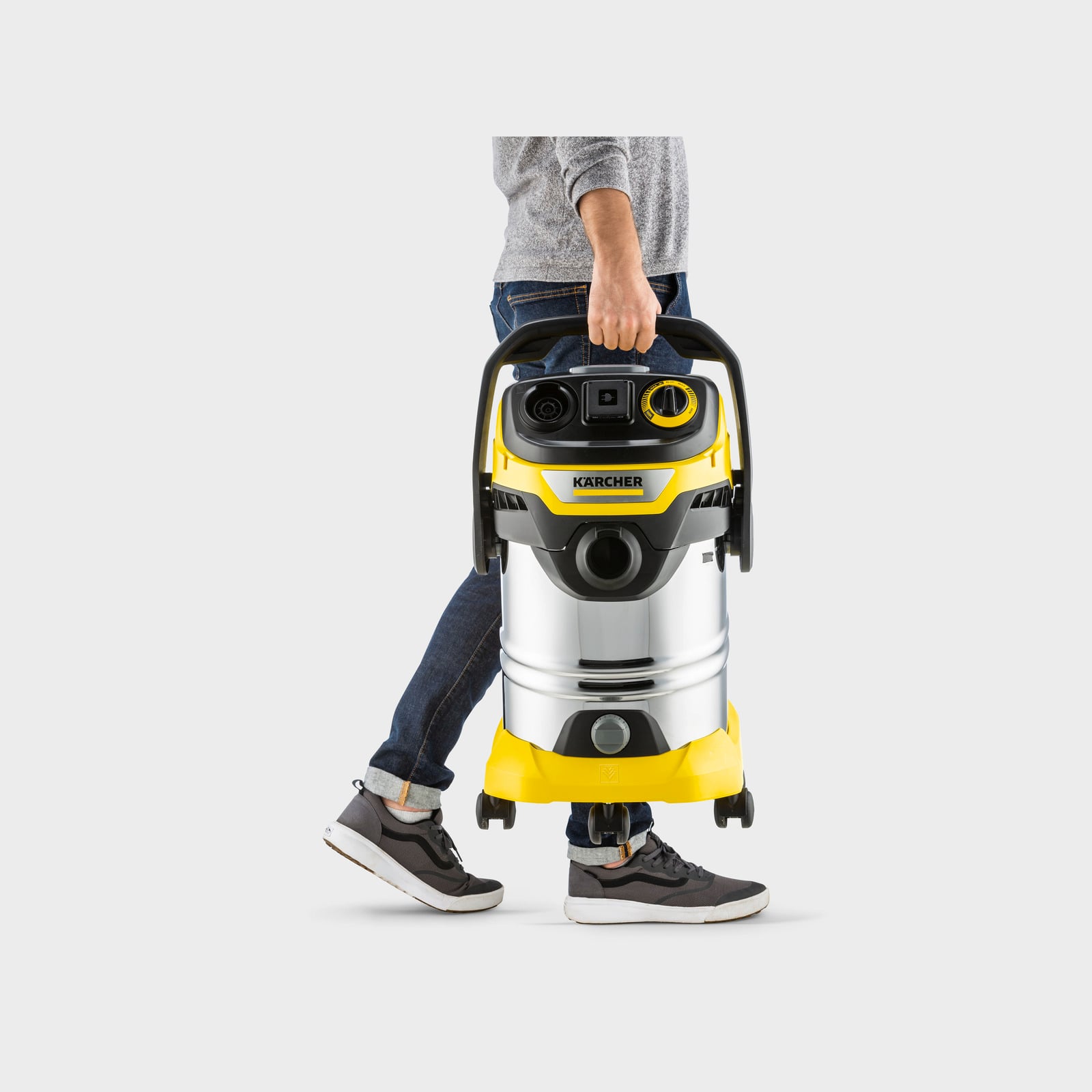
Exact Australian WD 6 Premium product image.
The exact Australian WD 6 Premium uses a 1300W input and a 30L stainless-steel tank. Its integrated power-tool socket supports automatic on/off operation with a compatible corded tool, allowing dust and debris from sawing or grinding to be collected as the tool runs. Its advantage is this workshop integration—not an unverified suction-number comparison.
The flat-fold filter sits in a removable cartridge in the device head. Under Kärcher’s Australian product wording, the architecture supports wet and dry dirt pickup without routine filter replacement between modes. Integrated filter cleaning allows a loaded filter to be cleared using the clean-out control to restore performance.
Wet cleanup is helped by the drain screw, while the blower function covers places where vacuuming is difficult. Hose storage and dedicated small-tool/accessory storage make the large machine easier to organise, and current Australian replacement filters and fleece bags support ongoing ownership.
At $399, the WD 6 Premium costs much more than the value pick and its 30L construction needs meaningful storage space. The Bunnings owner pool is mature and positive rather than flawless, and consumables remain an ongoing cost. It is also a consumer wet/dry vacuum—not a substitute for required M-class or H-class hazardous-dust extraction.
What owners say
Pros
- Automatic power-tool socket and tool start
- Integrated filter cleaning
- Convenient mixed wet/dry filter architecture
- 30L stainless tank with drain
- Blower and useful onboard storage
Cons
- $399 is expensive beside basic shop vacs
- Large 30L machine needs storage space
- Bags and replacement filters add cost
- Not the right choice for light occasional cleanup
- Not a certified M-class/H-class extractor
Ryobi 1250W 20L Wet & Dry Vacuum RVC-1220I-G
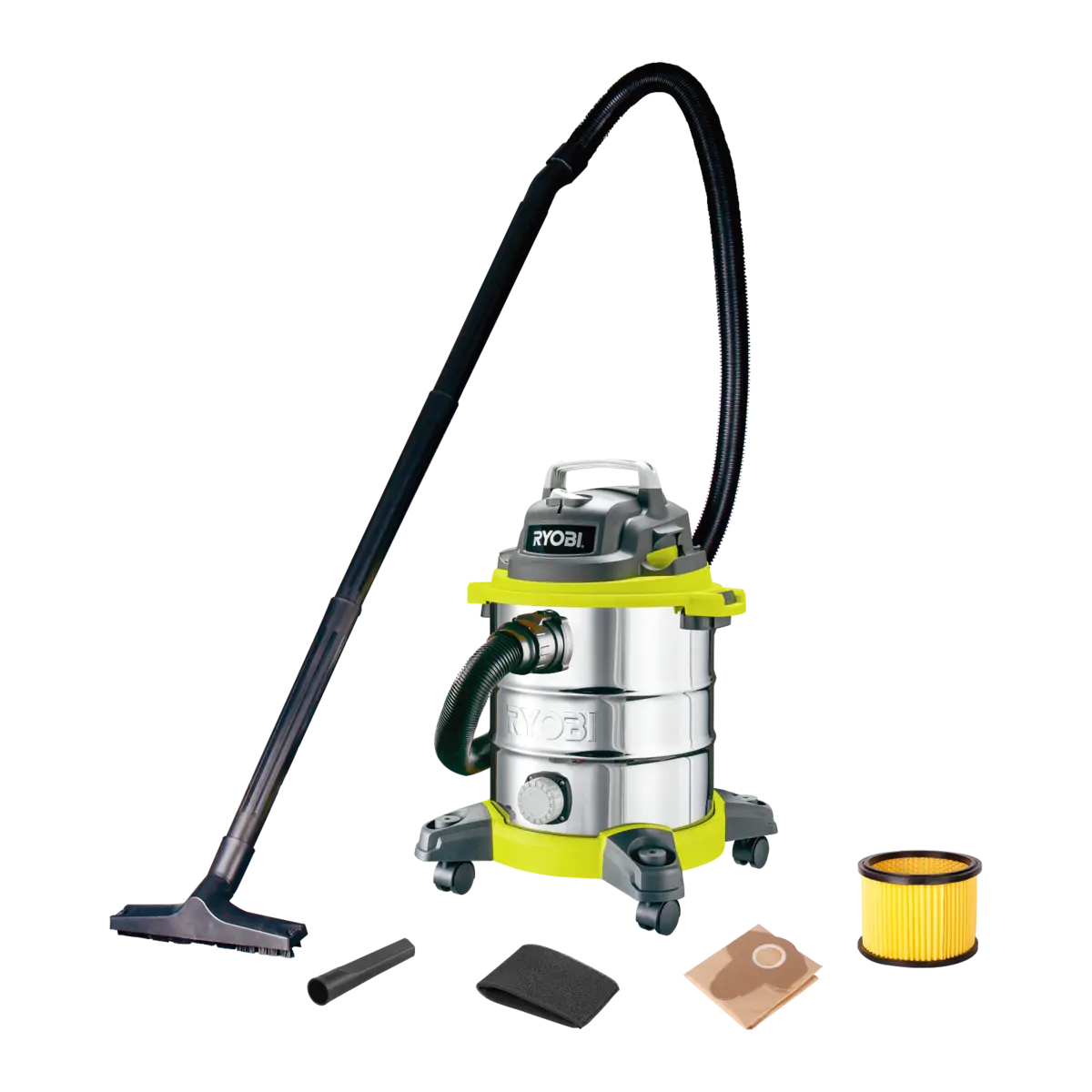
Exact-model product image.
The RVC-1220I-G is a conventional corded shop vacuum rather than a stripped household cleaner. Its 1250W motor drives 17kPa stated suction, while the 20L tank is large enough for ordinary DIY debris and spills without making the unit as cumbersome as a 30–40L workshop machine. Castors, on-board accessory storage, a floor tool and crevice nozzle keep the package practical.
Its wet and dry setup needs attention. The supplied cartridge filter and dust bag suit dry work, while liquid pickup requires the specified foam wet filter and the dry paper filter and bag must not be used. Following the manual matters: a large review count does not make incorrect filter setup harmless. Current sources disagree on the hose length, so the included workshop hose is not used as a prominent comparison differentiator.
The biggest feature omission is a power take-off socket. You can use the vacuum near power tools with the correct adapter and safe setup, but it will not automatically start when a corded tool runs. There is also no self-cleaning HEPA system. For occasional sanding, sawdust and garage cleanup those omissions may be acceptable; for frequent tool extraction they explain much of the price gap.
What owners say
Pros
- Exceptional $119 price
- Very large exact-model owner pool
- Useful 20L stainless tank
- Wet pickup and blower mode
- Simple, conventional design
Cons
- No power-tool socket or auto-start
- No automatic HEPA filter cleaning
- 4m cord limits working reach
- Basic hose and accessory design
- Correct wet/dry filter setup is required
Ryobi 18V ONE+ 11L Wet & Dry Project Vacuum RWDV1811
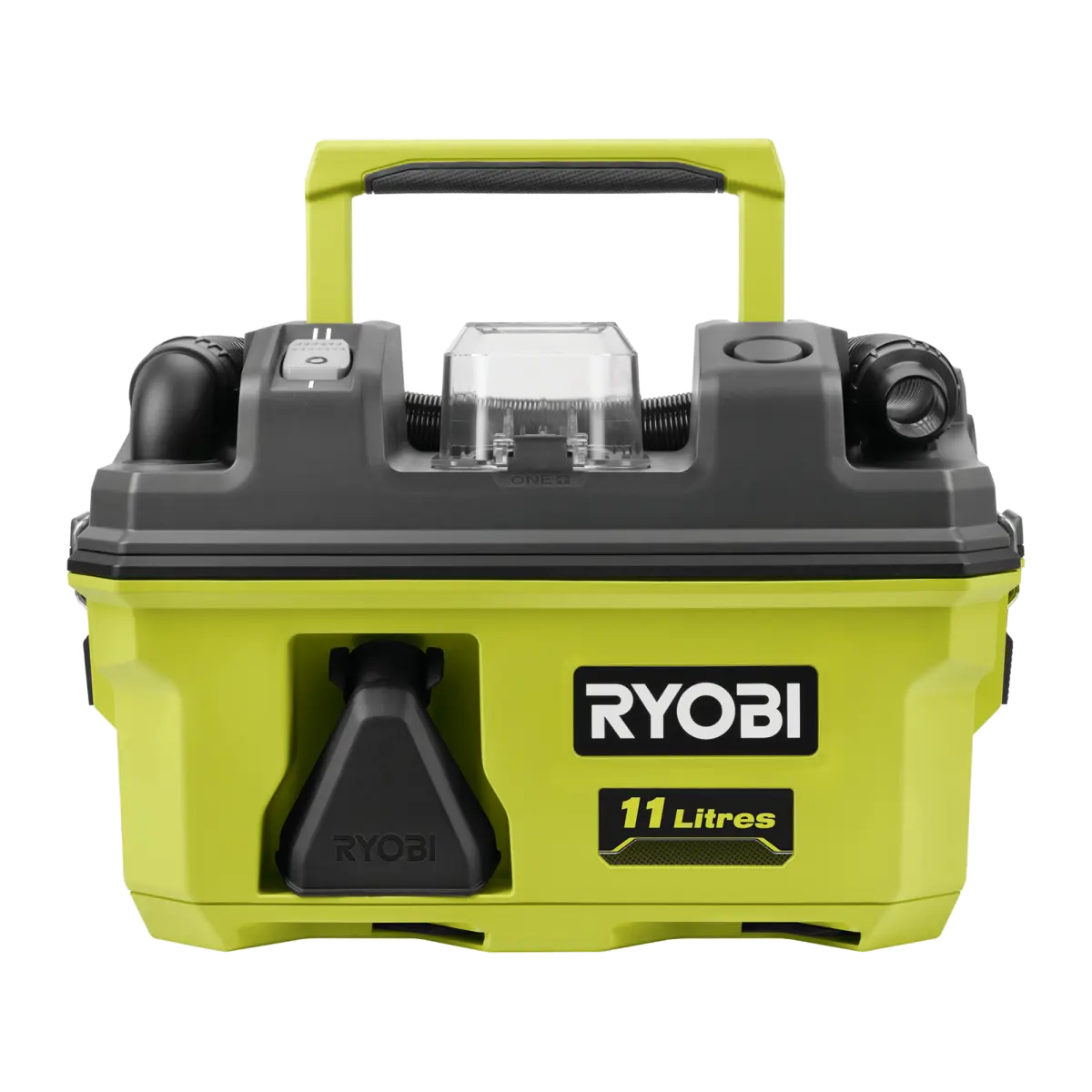
Exact-model product image.
The RWDV1811 solves a different problem from the big corded machines. At 4.5kg tool-only, with integrated storage and no mains cable, it is easier to carry into a car, across a shed or to a small spill. Its 13.5kPa stated suction is below the corded picks, but the combination of two speed settings, blower mode, crevice and wide nozzles and a power-tool adapter covers mobile cleanup well.
The washable HEPA 13 filter is a meaningful distinction. Ryobi says it captures 99.95% of fine dust and particles, but that manufacturer filtration claim does not turn the vacuum into a certified hazardous-dust extractor. The filter still needs inspection, cleaning and correct use, and the IPX4 battery cover does not remove the need to follow wet-pickup instructions.
Price depends heavily on battery ownership. The $199 figure is tool-only, with battery and charger sold separately. Ryobi states up to 24 minutes with a 4Ah battery, but that is a manufacturer claim rather than guaranteed high-power runtime. Actual time changes with selected speed, battery capacity, filter condition, debris and suction load.
The 11L tank is enough for quick garage jobs, benches, vehicles and small spills but cannot replace a high-capacity workshop machine. Buyers who would purchase a battery ecosystem solely for this vacuum should compare full kit cost, not the bare-tool headline.
What owners say
Pros
- Portable 4.5kg tool-only design
- Washable HEPA 13 filter
- Two speeds and blower mode
- Strong exact-model owner evidence
- Good fit for existing ONE+ owners
Cons
- $199 excludes battery and charger
- Only 11L capacity
- Less suction than large corded models
- Runtime limits longer jobs
- Not a high-capacity or classified extractor
Wet & dry vacuum buying guide
Compare suction figures carefully
Manufacturers publish different measurements: kPa, mbar, airflow in litres per second, suction watts and motor input watts. They are related but not interchangeable. Input wattage mainly describes electrical demand, not how much useful suction reaches the nozzle. A fair comparison considers vacuum, airflow, hose and filter design together where the manufacturer provides them.
Decide whether power-tool take-off matters
A power take-off socket can start the vacuum automatically when a compatible corded saw, sander, router or planer runs. It is one of the clearest reasons to choose the Kärcher over the cheaper Ryobi. Always check the socket’s maximum tool wattage and never exceed its rated limit.
Use the right filter configuration
Many machines need a cartridge or bag for dry work and a foam filter or bag-free setup for liquids. Kärcher’s flat-pleated cassette makes wet/dry changes simpler, but every machine still needs the manufacturer’s instructions followed. A clogged, wet or incorrectly installed filter can reduce performance or damage the vacuum.
Tank size changes both convenience and weight
About 20L is a useful size for ordinary DIY. A 30L machine handles larger workshop jobs and liquid pickup, while 40L-plus machines suit high-volume cleanup but take more storage. Water is heavy: a drain port becomes especially valuable once lifting and tipping a full tank is impractical.
Corded and cordless models serve different jobs
Corded vacuums offer sustained runtime and stronger performance potential for major cleanup. Cordless models excel in cars, small sheds, quick spills and places without a convenient outlet. Battery capacity, selected speed and filter condition all affect runtime, so a bare-tool price should never be compared directly with a complete corded machine.
Budget for bags, filters and accessories
Dry bags can improve dust handling, protect a filter and make emptying cleaner, but they add recurring cost. Before buying, check whether replacement bags, filters, adapters and nozzles are readily available in Australia. A lower purchase price can lose its advantage if consumables are scarce or disproportionately expensive.
Other serious contenders
Ryobi RACWDV40 · excellent large-capacity alternative
This $299 machine combines 1400W, a 40L tank, 20kPa stated suction, HEPA 13 dry filtration, foam wet filtration, integrated filter self-cleaning, a 1000W power take-off, speed control, blower, 2.5m hose, 5m cord and 10.8kg stated weight. Its roughly 4.8/5 Bunnings pool is only about 19 reviews, wet work requires the correct filter swap, and replacement 40L bags may need special ordering. It is a strong product, but the Kärcher’s mixed-mode filter architecture and more mature evidence keep the overall award.
DeWalt 34L StealthSonic
A strong quiet-workshop contender at about $350. Its approximately 4.4/5 Bunnings score comes from only eight reviews, leaving current exact-model Australian evidence too thin to displace the Kärcher.
Makita VC2012LX1
This $500-plus machine sits closer to dedicated dust-extractor territory. Its approximately 4.5/5 Bunnings rating comes from only four reviews, making it expensive and lightly evidenced for a general consumer wet/dry guide.
DeWalt DXV20P
At approximately $213, it is a credible mid-priced option, but its current Bunnings evidence is around 3.7/5 from nine reviews and does not provide a cleaner recommendation than the finalists.
Kärcher WD 3 P S
The $249 compact Kärcher adds power-tool integration and has around 4.0/5 from 22 Bunnings reviews. The WD 6 Premium offers a meaningfully stronger workshop package, while the Ryobi RVC-1220I-G remains dramatically cheaper for ordinary value buyers.
Ozito and classified extractors
Ozito still offers several very cheap wet/dry machines, but current $50-class 20L evidence is materially more mixed than the $119 Ryobi’s. Dedicated M-class machines from DeWalt, Makita, Nilfisk and other professional brands can be the correct choice for hazardous construction dust and are not direct substitutes for these consumer picks.
Which one should you buy?
Choose the Kärcher WD 6 Premium for the strongest general-purpose workshop setup. Its 30L stainless tank, automatic power-tool socket, filter cleaning, drain and convenient flat-fold filter system justify the premium for frequent DIY and mixed wet/dry work.
Choose the Ryobi RVC-1220I-G when value matters most. At $119 it is difficult to beat for ordinary garage dirt, spills and renovation debris if you do not need automatic power-tool activation and will use the correct wet filter setup.
Choose the Ryobi RWDV1811 when portability matters more than raw capacity. It is particularly compelling for existing ONE+ owners cleaning cars, benches, sheds and quick spills.
Frequently asked questions
What can a wet and dry vacuum pick up?
With the correct filter and setup, it can handle ordinary workshop dirt, sawdust, coarse debris and liquid spills. It is not automatically suitable for hot ash, flammable liquids, asbestos, silica or other hazardous dust. Follow the model’s manual and use a properly classified extractor where the hazard requires it.
Can I vacuum water with the filter installed?
It depends on the filter system. Some machines require a foam wet filter and no dust bag; others use a flat-pleated filter for both wet and dry pickup. Check the exact model instructions before collecting liquid rather than assuming its dry setup is safe.
Do I need a power-tool socket?
Not for general cleanup. It becomes valuable if you regularly connect a corded sander, saw, router or planer because a compatible socket can start the vacuum automatically. Check the permitted tool load and never exceed the socket rating.
Is a wet and dry vacuum safe for concrete or silica dust?
Do not assume so. Fine hazardous construction dust may require an M-class or H-class extractor plus suitable work controls and protective equipment. A consumer wet/dry vacuum is not a substitute merely because it has a HEPA-labelled filter.
Is cordless worth it for a workshop vacuum?
Yes when portability, quick jobs and existing battery ownership matter more than continuous runtime and maximum suction. For long sessions, large liquid volumes or sustained power-tool cleanup, a corded machine is normally the better fit.