How we chose
Queue 2.3 reassessed current Australian portable panels around the useful 200W class. The shortlist prioritises output-to-weight balance, setup and angle control, electrical compatibility, weather protection, warranty, current availability and clearly labelled customer or independent test evidence.
Manufacturer ratings and bifacial claims are treated as specifications, not guaranteed campsite output. Customer ratings, independent professional testing and Worth Buying editorial scores remain separate.
EcoFlow 220W Lightweight Portable Solar Panel
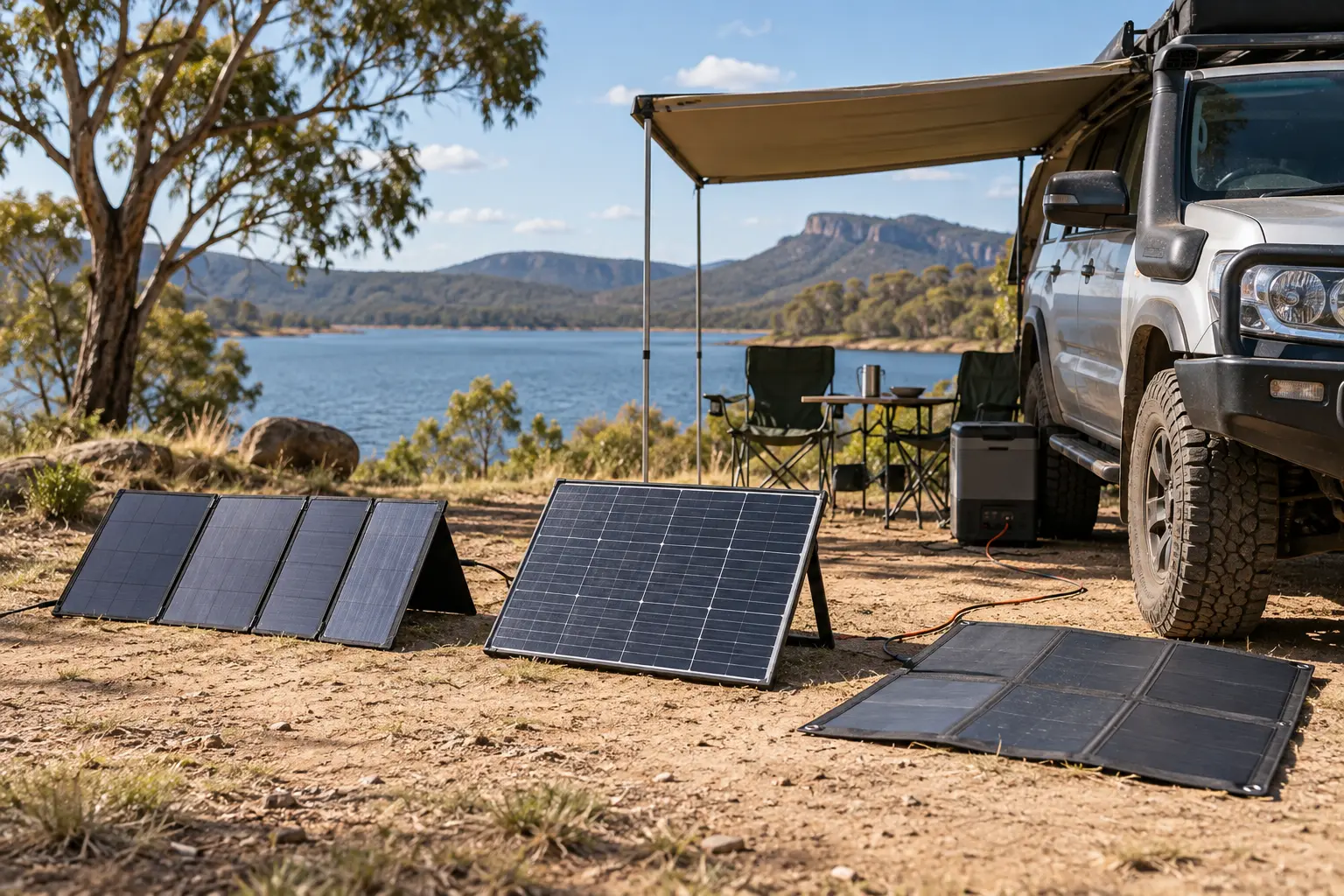
Illustrative editorial image, not an exact product photograph.
EcoFlow’s current NextGen bifacial panel is rated at 220W under STC and weighs only 5.1kg ±0.3kg. It uses N-type TOPCon cells, an integrated adjustable stand and angle guide, an integrated XT60 cable and IP68 protection. The researched direct price was about $529 promotional against a $699 reference price, but EcoFlow direct showed sold out or pre-order status.
EcoFlow also quotes up to 243W under its BNPI bifacial conditions. That does not turn it into a 243W panel: rear-side gain depends heavily on reflected light, ground surface and setup.
Strong specification and market case; limited exact Australian owner evidence
EcoFlow Australia displayed three reviews on the current exact-product page. Larger shopping and retailer pools exist, but their Australian exact-model provenance varies, so they are not converted into a clean local owner score.
Pros
- Excellent output-to-weight balance
- IP68 protection
- Useful angle guide and stand
- Five-year warranty
- Convenient EcoFlow integration
Cons
- Costs more than Renogy
- Direct stock was unavailable during research
- Non-EcoFlow systems may need adapters
- Bifacial gain is setup-dependent
- Large unfolded footprint
Renogy E.Flex 200W Portable Solar Panel RPP200EF-SE-AU
Illustrative editorial image, not an exact product photograph.
The exact current Australian SKU was about $324.99 direct and around $324 through BIG W marketplace, although Renogy direct was backordered. Its current AU specification lists 200W, more than 25% claimed cell efficiency, a 6.3kg weight, IP65 protection and a two-year warranty.
Some retailer pages still show 23.5% efficiency, 8kg and slightly different electrical figures, apparently reflecting an older or alternate revision. The current exact AU SKU and its supplied connector set should be checked rather than mixing generations.
Positive direct-owner feedback plus independent Australian real-world testing
Renogy AU showed nine manufacturer-hosted reviews: 89% five-star and 11% four-star. Separately, 4WDing Australia reported about 135W easily achieved and roughly 146W maximum in its conditions, praising portability, setup and value while preferring Anderson connectivity. Those field results are useful context, not a universal output promise.
Pros
- Much cheaper than premium picks
- Useful adjustable stands
- Independent Australian field evidence
- Portable folded size
- Broad compatibility potential
Cons
- Direct stock was backordered
- IP65 rather than IP68
- Old/current specification conflict
- Real output was below nameplate in field testing
- Adapters or controller may be needed
Jackery SolarSaga 200W
Illustrative editorial image, not an exact product photograph.
The current bifacial SolarSaga is rated at 200W ±5% under STC, weighs 6.2kg and carries IP68 protection. Adjustable stands, direct USB-A and USB-C outputs and close compatibility with Jackery power stations make it particularly convenient inside that ecosystem.
BCF listed it at $600 clearance against a previous $799 price; Jackery direct reference pricing was about $699–$799 and direct stock was sold out. BCF lists a three-year warranty, while Jackery’s direct 3+2-year program has purchase conditions and should not be assumed to apply through every retailer.
Excellent independent test performance; very limited exact Australian owner evidence
OutdoorGearLab scored the exact panel 84/100 and ranked it second of 12 tested, highlighting power efficiency, portability and setup while criticising price. BCF and Jackery Australia did not expose a substantial local exact-model owner pool during research. Global manufacturer feedback is not presented as Australian customer evidence.
Pros
- Excellent independent test result
- IP68 protection
- Good portability and setup
- Direct USB-A and USB-C
- Strong Jackery compatibility
Cons
- Expensive
- Direct Jackery stock was sold out
- Adapters may be needed outside Jackery
- Very limited Australian owner evidence
- Clearance pricing may not last
Rated watts versus real output
A 200W nameplate is a controlled test rating, not a promise of 200W throughout the day. Sun angle, cloud, panel temperature, partial shade, dirt, cable loss, controller efficiency and the power station’s solar-input limit all affect what reaches the battery.
Bifacial ratings need the same care. EcoFlow’s 243W and Jackery’s 208W figures use specified bifacial test conditions; rear-side contribution depends on reflected light and how the panel is raised and angled.
Folding panel or solar blanket?
Folding panel
Usually easier to hold at a useful angle with integrated stands. It can be bulkier when packed, but the supported setup often produces better results than laying a blanket flat.
Solar blanket
Can pack smaller, weigh less and drape over a vehicle or awning. It may lose substantial output if placed flat, gets hotter against surfaces and can be awkward to aim consistently.
MPPT, voltage and connector compatibility
A conventional 12V battery needs a suitable solar charge controller unless its charging system already includes one. Portable power stations normally have their own MPPT solar input, so adding another regulator in series is usually wrong unless the manufacturer explicitly specifies it.
Check Voc, Vmp, current, maximum solar input, polarity and connector before buying. Common connections include MC4, Anderson, XT60/XT60i and proprietary Jackery DC plugs. Adapters solve only the physical connection; they do not make incompatible voltages or currents safe.
Angle, shade and weather protection
A panel aimed toward the sun can materially outperform the same panel lying flat. Re-aim it as the sun moves, and keep cells clear of tree branches, awnings, roof shadows and camping equipment—partial shade can sharply reduce output.
IP65 and IP68 are different protection levels, and neither automatically means a folding panel should live outside permanently. Follow the exact model’s handling guidance, keep connectors protected and pack the panel away when it is not in use.
Which one should you buy?
Choose EcoFlow for the best output-to-weight balance and strong weather protection. Choose Renogy when value and adaptable system compatibility matter most. Choose Jackery if you already use an Explorer power station and want the most polished ecosystem fit.
Frequently asked questions
What is the best portable solar panel in Australia?
The EcoFlow 220W Lightweight is the best overall pick here for its 220W rating, 5.1kg weight, IP68 protection and five-year warranty. Renogy offers better value, while Jackery best suits Explorer owners.
Is a 200W solar panel enough for camping?
It can be a useful size for fridges, lighting and topping up a portable power station, but adequacy depends on daily energy use, available sun, battery size and the system’s input limit.
Why does my 200W panel not produce 200W?
The rating comes from standard test conditions. Real output falls with imperfect sun angle, heat, haze, cloud, shade, dirt, cable loss, controller inefficiency and input limits.
Do I need a solar regulator with a portable panel?
You need a suitable controller when charging a raw 12V battery unless the charging system already includes one. Most power stations have an internal MPPT input and normally accept the compatible panel without a second regulator.
Is a solar blanket better than a folding solar panel?
A blanket packs smaller, but a folding panel is usually easier to angle and support. The better choice depends on vehicle storage, setup space and how reliably you can aim it at the sun.