
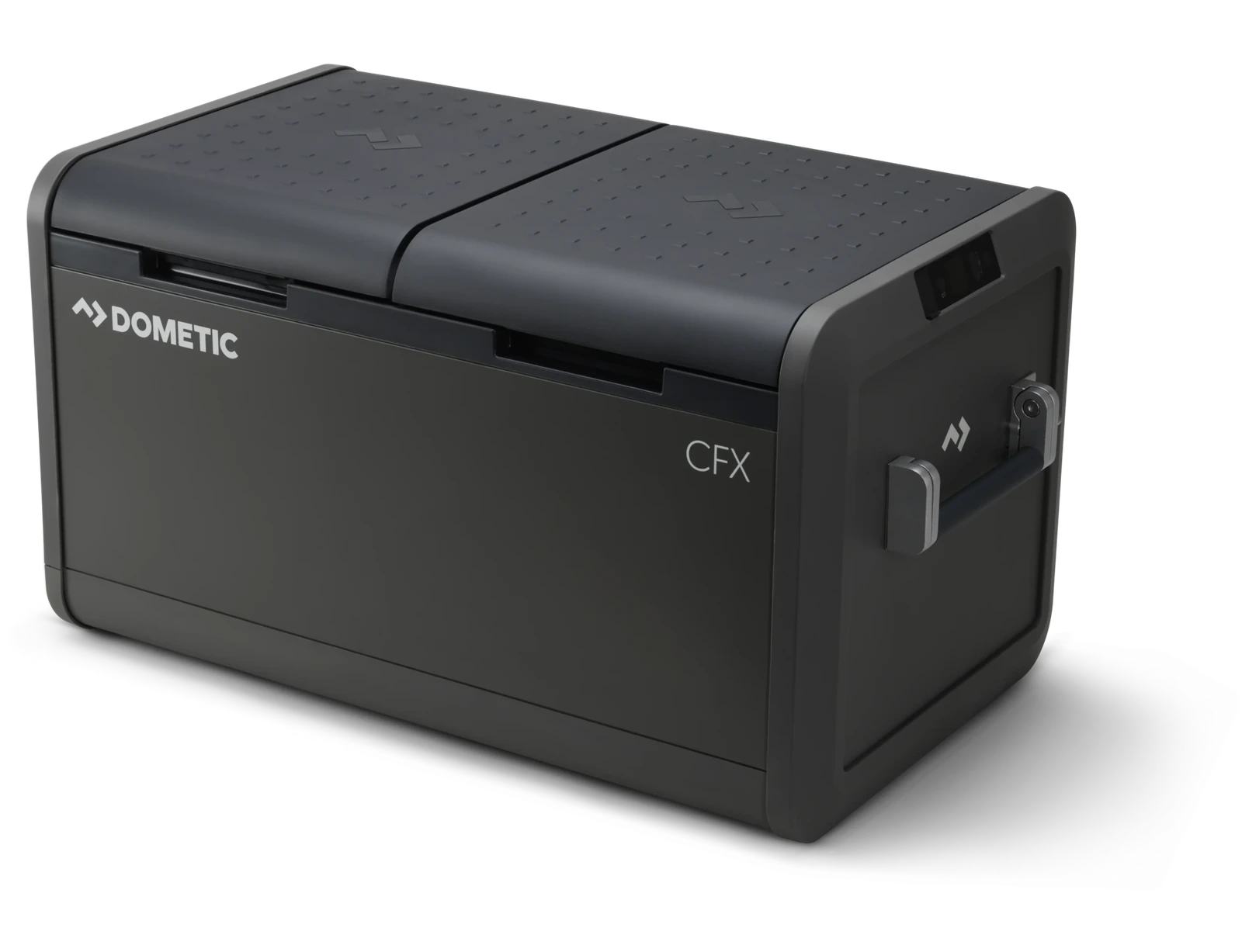
Dometic CFX5 75DZ Dual Zone Fridge Freezer
Exact model: CFX5 75DZ · Australian SKU 9620015962 · 75 L (45 L + 30 L).
Specifications
| Item | Specification |
|---|---|
| Capacity and control | 75 L; independent 45 L and 30 L zones |
| Temperature | Minimum setting −22°C; the manual limits the deepest freezer setting in high ambient heat |
| Supply | 12/24 V DC and 100–240 V AC |
| Dimensions and mass | 892 W × 495 D × 472 H mm; manufacturer-listed net weight 27.7 kg (Australian SKU page; see analysis) |
| Cooling and controls | VMSO3.5 compressor, Vacuum Insulated Panels and colour TFT display |
| Connectivity and protection | Bluetooth in current Australian documentation; three-stage battery protection |
| Manufacturer draw | 2.45 Ah/h at 12 V, +4°C large zone / −15°C small zone, 32°C ambient |
| Express warranty | Five years, subject to the Australian terms |
Extended product analysis
Storage and vehicle fit.
The 45 L and 30 L zones let you change how much food you chill or freeze without changing fridges. That flexibility is the main reason to choose this model over Engel's fixed-role combi. The trade-off is a cabinet 892 mm wide: check the slide and access in your vehicle before ordering. Dometic's Australian SKU page lists 27.7 kg net; its APAC manual lists 31.1 kg without stating the weight basis. Confirm the supplied unit's weight if it matters for your setup, and include food, drinks and a slide when checking the load.
Power and hot-weather use.
Dometic publishes a useful consumption figure with zone and ambient temperatures attached. It helps explain the test, but it is not a promise of daily battery use on your trip. External testing has reported encouraging temperature control and holding consumption; an empty-zone mains test and sponsored touring observations do not establish a like-for-like Australian summer efficiency win. Leave the manual's ventilation clearance—at least 50 mm on all sides—and do not enclose the fridge in an unventilated compartment. Check food temperature rather than relying on the displayed setting.
Controls and connectivity.
Current Australian documentation describes Bluetooth app control. Older manuals and some retailers also mention Wi-Fi, so check the documentation for the unit being supplied if that feature matters.
Pros
- True independent zones
- Flexible fridge/freezer combinations
- Published power figure with stated test conditions
- Five-year Australian warranty, subject to terms
Cons
- Premium purchase cost
- Large 892 mm-wide footprint
- A substantial load once food, drinks and a slide are included
- Current-model long-term evidence is still developing
- Connectivity documentation differs between current and older sources
You want flexible independent zones and can accommodate the cabinet and premium outlay.
You need a compact fridge, a lower purchase cost or an established long-term record for this exact generation.
This recommendation is for the Dometic CFX5 75DZ, rather than an older CFX3 model.
Engel MT-V60JC Combi Twin Door Fridge Freezer
Exact model: MT-V60JC · 57 L. Current documented naming also includes COMBI-MT-V60C; confirm the current twin-door model in the offer.
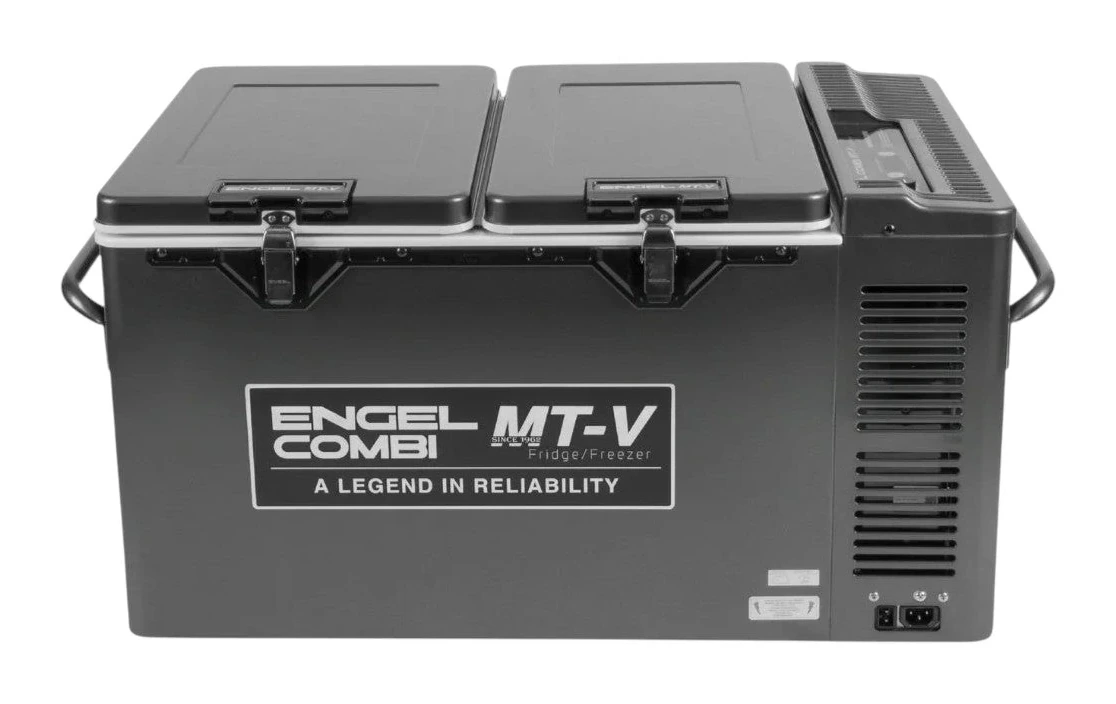
The 57L cabinet is divided into a dedicated 32L fridge and 25L freezer. Each has its own reversible door, but the temperature relationship is linked: a thermostatically controlled internal fan circulates cold air between compartments. This is not the same as two independently settable fridge/freezer zones.
Specifications
| Item | Specification |
|---|---|
| Capacity and layout | 57 L; dedicated 32 L fridge and 25 L freezer; twin reversible doors |
| Cooling | Sawafuji Swing Motor; linked compartments with fan-circulated cooling |
| Control | Fixed fridge/freezer roles; not independently configurable |
| Supply | 12/24 V DC and built-in 240 V AC; automatic voltage selection |
| Body dimensions | Manufacturer: 803 W × 520 D × 441 H mm |
| Fit allowance and empty mass | 60 mm allowance per handle; 34 kg empty |
| Protection and current | Three-stage battery protection; variable 0.5–3.6 A, not a daily average |
| Express warranty | Five years cooling unit; three years power supply/temperature control; one year cabinet/hinges/cords; terms apply |
Extended product analysis
A fixed split with separate access.
The twin-door layout lets you reach chilled or frozen food separately, but it does not turn either compartment into whichever role you prefer. If your usual load suits a 32 L fridge and 25 L freezer, that can be straightforward to live with. If the balance changes between trips, Dometic or myCOOLMAN gives you more flexibility. Keep the internal airflow path clear when packing.
Weight and installation.
Engel lists the body at 803 W × 520 D × 441 H mm, with 60 mm allowance per handle. Those figures do not supply a complete installed width: allow separately for handle projection, lid opening, ventilation, cables and the slide. Its 57 L capacity is the lowest listed here, and its 34 kg empty weight needs care when lifting. Add the contents and mounting equipment when checking payload, and arrange help to lift it.
Construction and controls.
The steel cabinet, Sawafuji Swing Motor and built-in AC/DC operation retain Engel's traditional touring approach. No app is needed. That is useful for buyers who prefer controls at the fridge, but platform history alone does not demonstrate superior reliability or lower power consumption for this twin-door model. Its variable current specification cannot be turned into daily battery use without a duty cycle.
Ownership and warranty.
Engel's warranty is component-specific: five years for the cooling unit, three for the power supply and temperature control, and one for the cabinet, hinges and cords, subject to terms. A five-year headline should not be read as five-year cover for every part. Express warranty terms do not replace rights under Australian Consumer Law.
Pros
- Dedicated fridge/freezer layout with separate reversible doors
- Steel cabinet and established compressor platform
- No app or cloud dependency
- Built-in AC/DC operation
Cons
- Fixed roles and linked cooling limit flexibility
- 34 kg empty for 57 L capacity
- Premium purchase cost
- Shorter warranty cover for several components
A fixed 32 L fridge and 25 L freezer suits your trips and you prefer separate lids and controls without an app.
You want to change either zone between fridge and freezer, need lower weight or expect the five-year warranty to cover every component.
This recommendation is for the Engel MT-V60JC/current documented COMBI-MT-V60C twin-door model. Some current seller URLs retain older model names; check the current model in the listing and order. Its combi compartments have fixed roles.
myCOOLMAN CCP69DZ 69 L Dual Zone Fridge & Freezer
Exact model: CCP69DZ / 69 L Traveller.
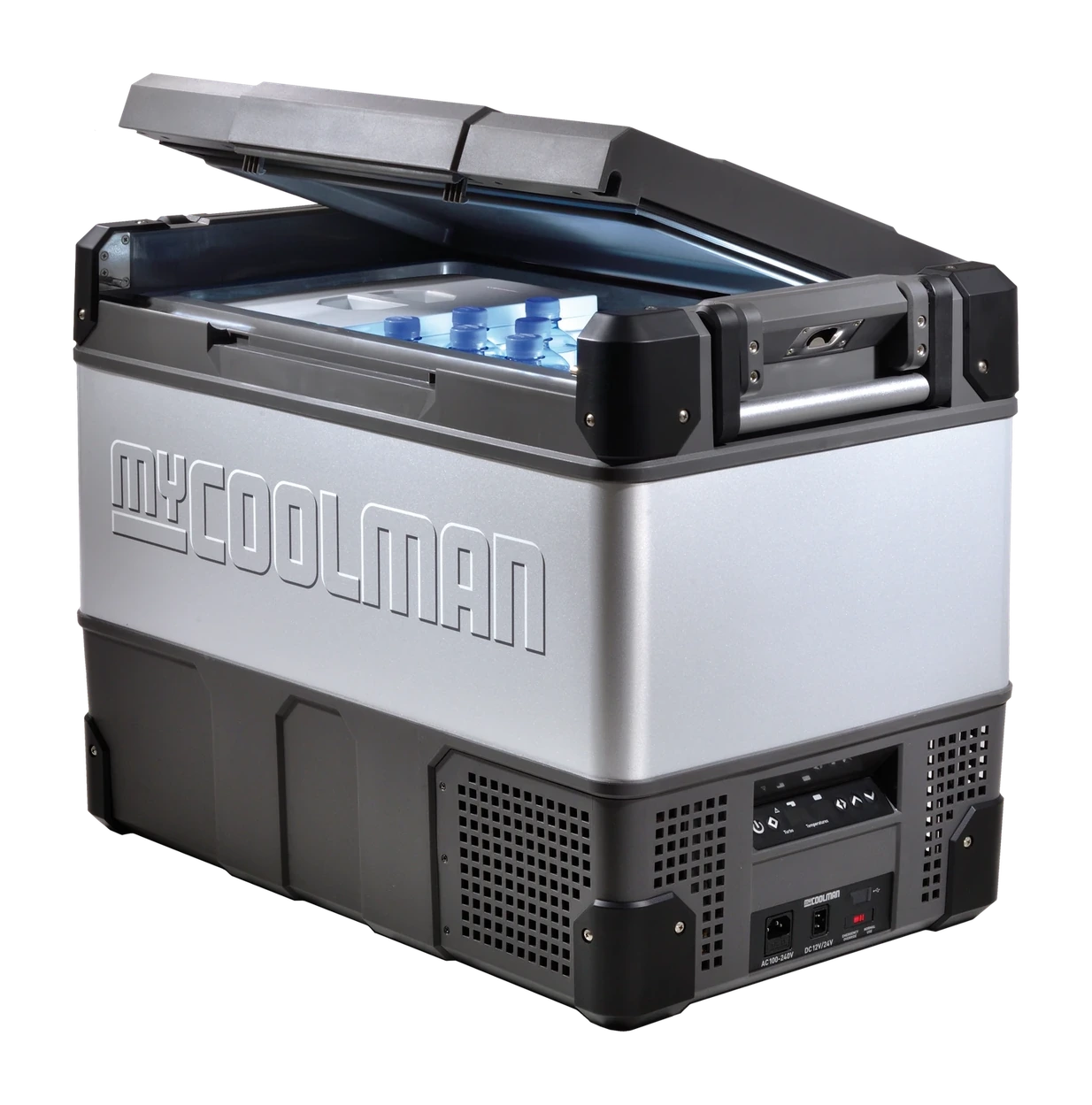
The CCP69DZ combines 69 L capacity with genuine dual-zone control, 12/24 V DC and AC operation, Bluetooth monitoring, a Blue-Gen compressor, dual DC inputs and a reversible two-way lid.
Specifications
| Item | Specification |
|---|---|
| Capacity and control | 69 L listed capacity; independent 24 L and 45 L zones |
| Temperature settings | +10°C to −22°C; either zone can be fridge or freezer |
| Supply | 12/24 V DC and 100–240 V AC; dual DC inputs |
| Dimensions and empty mass | 732 L × 456 W × 555 H mm; 29.4 kg |
| Compressor and controls | Blue-Gen compressor, digital controls and Bluetooth |
| Access and protection | Reversible two-way lid; three-stage LO / MED / HI battery protection |
| Manufacturer draw | 2.9 Ah/h at 12 V; +3°C fridge / −15°C freezer; 32°C ambient |
| Express warranty | Current manufacturer manual: comprehensive five-year cover against defects in materials and workmanship; check terms for the purchase |
Extended product analysis
Storage and access.
The independent zones give you more freedom than Engel's fixed-role combi, while the 24 L and 45 L split lets you plan chilled and frozen loads separately. The cabinet is shorter along its long side than the Dometic but taller, so check lid clearance and access on your slide. Listed capacity is not a measurement of the food you can fit around baskets and packaging. The two-way lid and dual DC inputs offer useful installation flexibility without making every orientation suitable.
Power in context.
myCOOLMAN publishes 2.9 Ah/h at 12 V with the fridge at +3°C, freezer at −15°C and ambient temperature at 32°C. That gives you a useful starting point for battery planning, with the conditions kept in view. The different settings and test details prevent a direct efficiency ranking against Dometic. An Australian owner's covered, partly loaded garage test provides useful additional context, but its conditions do not promise a runtime on your trip.
Warranty and offer contents.
The current manufacturer manual states comprehensive five-year cover against defects in materials and workmanship. Older retailer descriptions show different terms; compare the written cover for the purchase you make rather than assuming the newer wording applies retrospectively. Seller bundles also vary. A compatible PowerPack is not automatically included, and an advertised cover or ice box belongs to the particular offer rather than every CCP69DZ purchase.
Pros
- Independent 24 L and 45 L zones
- Lower purchase cost than the premium picks in our comparison
- AC/DC operation, Bluetooth and dual DC inputs
- Reversible two-way lid
- Current manufacturer manual states comprehensive five-year defect cover
Cons
- 29.4 kg before loading
- Tall cabinet needs careful access and lid-clearance checks
- Limited long-term exact-model evidence
- Bundle contents and written warranty descriptions vary between offers
You want independent-zone family-touring capacity and a lower purchase cost, and the cabinet fits your vehicle.
You need a lighter unit.
This recommendation is for the myCOOLMAN CCP69DZ. Compare bundle contents and written warranty terms before buying.
What to know before buying a dual-zone camping fridge
Buying advice
What true dual-zone control means
Two independently controlled compartments have separate temperature settings, allowing combinations such as fridge + freezer, freezer + fridge or two fridge zones where the exact model supports them. A combi unit can still provide excellent simultaneous chilled and frozen storage, but its compartments may have fixed roles or a linked temperature relationship. Two lids alone do not prove independent control.
Zone size and fridge/freezer combinations
Total litres can hide an awkward split. Dometic's 75L is divided into 45L and 30L zones, while Engel uses a fixed 32L fridge and 25L freezer. Think about which foods need freezing, whether tall bottles fit, and which side remains accessible on the fridge slide—not just the total capacity.
myCOOLMAN divides its listed 69 L into 24 L and 45 L compartments. Think about the usable basket space and the meals you actually carry; advertised litres alone do not settle the fit.
Power use and battery planning
Running one zone as a freezer can use substantially more energy than running both as fridges. Ambient heat, loading, insulation, ventilation, lid openings and set points all affect consumption, so do not turn one published amp-hour figure into a guaranteed battery-runtime claim. Off-grid fridge-plus-freezer use generally needs more battery and solar capacity than a comparable single-zone fridge.
There is no universal daily figure. A manufacturer test, an empty indoor measurement and a loaded hot-weather trip describe different jobs. Compare temperature settings, ambient heat, loading, ventilation, lid openings and how power was measured before using a number to plan a battery system. Allow for other loads, conversion losses and a reserve rather than treating nominal battery capacity as fully usable. Solar charging needs a suitable battery or regulated supply path; follow the fridge and charging equipment instructions.
Vehicle fit, weight and wiring
Check fridge-slide dimensions, lid clearance, vehicle payload and whether you can safely lift the fridge. Include food, drinks, the slide and mounting equipment when checking the loaded weight, and arrange help to lift it.
Engel's current manufacturer body dimensions are 803 W × 520 D × 441 H mm, with 60 mm allowance per handle. Keep body dimensions separate from handle projection and lid, ventilation and cable clearances; there is no single guaranteed installed envelope here.
Long, thin 12 V wiring can cause voltage drop and low-voltage errors. Use the specified fused connection and get qualified advice for a permanent installation. Preserve the supplied protective plugs and protection settings; a voltage-drop shutdown needs diagnosis rather than simply lowering the cutout.
Service access matters for expensive remote-touring equipment. Warranty length, Australian technicians and availability of compressor, thermistor, control-board, cable and lid hardware can matter more over time than an app feature.
Food temperature and ventilation
Use a separate thermometer to check perishable food stays at 5°C or colder, including near the top of a loaded compartment. Leave room for air to circulate. Pre-chill food safely before packing and keep raw meat in sealed containers. The display setting does not prove every part of the load is at that temperature.
Keep the ventilation openings clear and follow the exact manual's installation clearances. Dometic specifies at least 50 mm on all sides and rules out closed, unventilated compartments. Keep the fridge secured and protected from direct sun and rain as directed by its manual.
Which one should you buy?
Choose the Dometic CFX5 75DZ when flexible independent zones and a premium touring package justify the outlay and its wide cabinet fits. Choose the Engel MT-V60JC when a dedicated 32 L fridge and 25 L freezer, separate lids and no app suit the way you travel, and you can manage the weight. Choose the myCOOLMAN CCP69DZ when you want independent-zone flexibility at a lower purchase cost and have checked the seller's support and bundle terms.
Dometic and myCOOLMAN both score 8/10 for different strengths and compromises; Engel scores 7/10 as a more specialised fixed-role option.
How we chose
Detailed methodology
We compared current Australian models by zone design, capacity split, power options, insulation, battery protection, vehicle fit, warranty, service support and customer evidence from each source. Worth Buying scores are editorial assessments and remain separate from customer ratings.
We distinguished true independent zones from a twin-door combi layout. We also treated manufacturer consumption and temperature figures as conditional specifications, not Worth Buying laboratory measurements or guaranteed battery runtime.
Frequently asked questions
What is the best dual-zone camping fridge in Australia?
It depends on the job. Our premium independent-zone pick is the Dometic CFX5 75DZ; the myCOOLMAN CCP69DZ is the lower-cost independent-zone pick. Engel's MT-V60JC suits a fixed fridge/freezer split with separate lids. The evidence does not establish one universal winner for efficiency, reliability and lifetime value.
What is the difference between dual zone and fridge/freezer combi?
A true independent dual-zone fridge has separate temperature control for each compartment. A combi may use fixed fridge and freezer roles with a linked cooling relationship, as the Engel MT-V60JC does.
Can both zones be used as freezers?
The Dometic CFX5 75DZ supports independently configured fridge or freezer zones. Do not assume the same for every twin-lid unit; Engel's MT-V60JC has dedicated fridge and freezer compartments.
How much battery power does a dual-zone fridge use?
There is no universal figure. Ambient temperature, zone settings, loading, ventilation and lid openings matter, and freezer operation usually increases demand. Use model-specific test conditions when planning a battery system.
Is a dual-zone fridge worth the extra size and weight?
Yes when you genuinely need chilled and frozen food at the same time. For shorter trips or buyers who rarely freeze food, a smaller single-zone model is easier to lift, fit and power.