How we chose
We assessed current Australian exact models, availability, new-stock pricing, total and practical capacity, chopping, slicing, grating, dough work, specialist attachments, feed chutes, cleaning, storage, owner evidence and its provenance, professional testing, warranty, parts support and long-term value. Manufacturer specifications and external testing remain separately attributed. Worth Buying Australia has not physically laboratory-tested these processors.
Magimix 5200XL
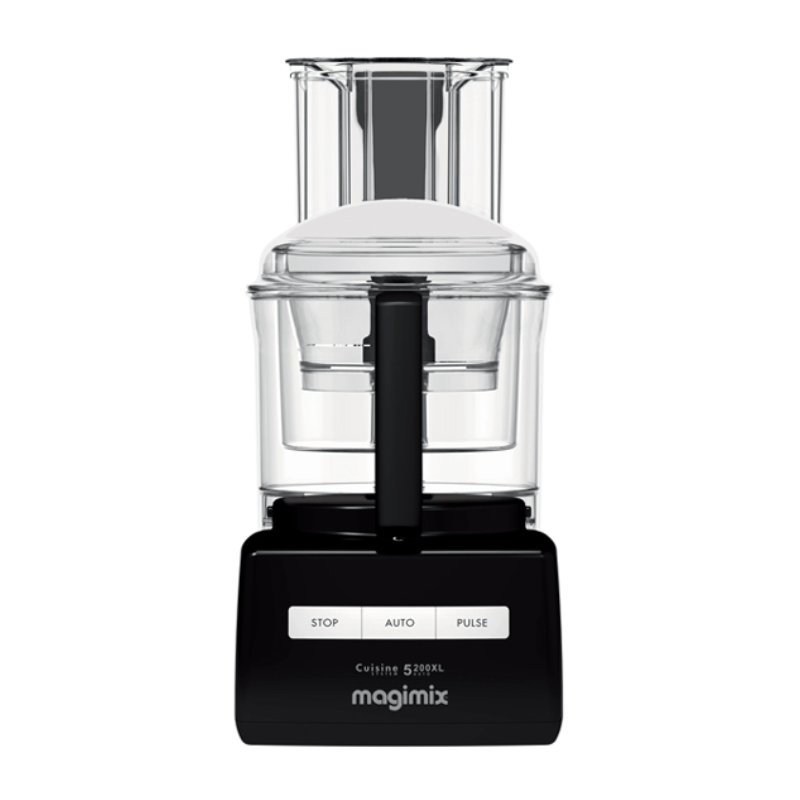
Magimix 5200XL shown.
The 5200XL uses a 1100W induction motor and three nested bowls. The 3.6L figure is the total capacity of the main bowl, not a promise that every preparation can safely use 3.6L. Practical working capacity depends on the food and attachment; Magimix examples include about 1.2kg of dough and roughly 1kg of vegetables for grating.
The mini, midi and main bowls let the machine move from small sauces to family-scale prep without turning the controls into a dashboard. The standard set covers chopping, slicing and grating at 2mm and 4mm, kneading, whisking, BlenderMix-supported blending and citrus pressing. The XL feed tube and triple pusher reduce pre-cutting, while Sabatier stainless-steel blades and discs reinforce the durable, repairable positioning.
That breadth should not be confused with every possible attachment being standard. Precision dicing requires a separate accessory unless an eligible temporary promotion includes it. A September 2026 bonus-dicing offer is not treated as a permanent inclusion.
What owners say
Long-term replacement stories strengthen the durability case, but owners also mention the nested bowls creating extra washing and the machine's size and weight making cupboard storage inconvenient.
Pros
- Extensive exact-model Australian evidence
- Large-capacity three-bowl system
- Strong slicing, grating and dough capability
- Simple controls and broad core accessory set
- 30-year motor warranty and parts support
Cons
- High purchase price
- Approximately 11kg and awkward to move
- Nested bowls can create extra washing
- Dicing is not normally included
- Oversized for consistently tiny quantities
Ninja Professional Food Processor BN650 (Australian SKU BN650ANZ)

Ninja Professional Food Processor BN650 / BN650ANZ shown.
The 2.1L bowl is enough for everyday chopping, sauces, dips, shredding and moderate prep, although it is well below the 3.6L-total premium machines. Bowl capacity is not the safe working quantity for every ingredient, particularly dough and liquids. At roughly 3.2–3.4kg, it is much easier than the Magimix to move between a cupboard and the bench.
Four Auto-iQ functions—Chop, Puree, Slice and Mix—provide straightforward preset operation. The package includes a chopping blade, dough blade, reversible slicing and shredding disc, spindle, feed-chute lid, pusher and bowl. Removable parts are dishwasher safe under Ninja's stated conditions.
The Ninja's 850W motor should not be read as a direct score against the 900W Breville or 1100W Magimix. Gearing, blade design, torque and load handling matter too. Its practical compromise is the simpler attachment set: slicing thickness is not broadly adjustable and there is no included precision dicing system.
What owners say
Negative evidence includes an isolated complaint about blade-drive performance failing after several months. One report is material context, not evidence of a widespread defect.
Pros
- Excellent price-to-function ratio
- Proper 2.1L processor bowl
- Simple presets and easy everyday operation
- Strong retailer exact-model evidence
- Compact relative to premium processors
Cons
- Smaller bowl than Magimix and Breville
- No precision dicing system
- Limited slicing adjustment
- Lighter construction than Magimix
- Small independent evidence sample
Breville the Paradice 16 BFP838

Breville the Paradice 16 BFP838 shown.
The main bowl is described as 16 cup / 3.6L total capacity, while the included mini bowl is about 1L / 2.5 cup. Those figures do not mean every recipe or program can process the full nominal volume. The 900W high-torque induction motor drives chopping, mincing, pureeing, shredding, julienne, French fries, kneading and small-bowl work.
The headline difference is the included preparation hardware: 8mm and 16mm dicing systems, potato peeler, adjustable slicer with 24 positions, reversible shredding disc, French-fry disc, Quad blade, dough blade and mini blade. A feed chute up to about 140mm reduces pre-cutting. Two accessory-storage boxes keep the parts organised but require substantial cupboard space.
This breadth brings more sharp parts, grids, discs, spindles and cleaning tools. Even positive evidence notes that firmer foods can remain in a dicing grid. If a buyer mostly chops, slices and grates, the additional setup and washing can undermine the advantage.
What owners and professional testers say
The professional conflict is preserved rather than blended into a consensus. Core processing receives broad praise; confidence in the signature dicing proposition is materially lower.
Pros
- Exceptional included attachment range
- 8mm and 16mm precision dicing systems
- 24-position adjustable slicer
- Large main bowl plus mini bowl
- Strong professional coverage of core processing
Cons
- Expensive at $899 direct
- Very limited Australian owner evidence
- Conflicting professional dicing results
- Large machine plus two storage boxes
- Many sharp parts to clean and store
What matters when buying a food processor
Bowl size is not working capacity
A 3.6L bowl is a total-volume specification, not permission to process 3.6L of dough, liquid or chopped food. Each task can have a lower limit. Check the manual for the relevant blade, program and ingredient.
Watts are not a performance score
Motor power alone does not measure torque, gearing, blade design, processing consistency or durability. The 1100W, 900W and 850W figures here describe different systems and are not a valid ranking by themselves.
Feed-chute width saves preparation
A wider chute reduces pre-cutting for potatoes, cucumber, cabbage, cheese and larger produce. The blade or disc still determines the finished result, so chute width should be judged alongside the included tools.
Dicing requires real hardware
Most processors chop, slice and grate. Uniform cube-style dicing needs dedicated grids and discs. Breville includes two sizes; Magimix normally requires a separate accessory; Ninja BN650 does not include an equivalent system.
Dough changes the workload
Food processors can mix or knead small-to-moderate dough batches quickly. Frequent bread makers may still prefer a stand mixer for larger batches, particular hydration levels or a workflow that needs prolonged kneading.
Small jobs need a smaller bowl
A large main bowl can struggle with a few herbs, a tiny spice quantity or one garlic clove. Mini bowls improve versatility, while a simple mini chopper may still be more convenient for consistently small jobs.
Attachments create cleaning
Extra grids, discs, bowls, spindles and cases are useful only when the result is worth setup, washing and drying. Dishwasher-safe wording does not remove the need to handle sharp parts carefully or clear dicing grids.
Plan the storage first
The Magimix is approximately 11kg and the Breville adds two accessory boxes. Both suit permanent bench placement better than frequent lifting. Measure bench height, cupboard volume and feed-chute clearance before buying.
A food processor is the better tool for slicing, grating, chopping, dough and attachment-based preparation. A blender is usually better for smooth liquids, while a mini chopper is faster for genuinely tiny quantities. Combination systems trade specialisation for fewer appliances.
Other serious contenders
Magimix 4200XL remains an excellent premium processor with a large positive owner pool. It missed because the 5200XL cost only about $50–$60 more during research while adding capacity and power; a wider future price gap could change that value comparison. The compact Magimix 3200XL is also credible, but Ninja owns the lower-cost value position.
KitchenAid KFP1319 combines 13-cup capacity, adjustable slicing and dicing with a very large positive KitchenAid-hosted pool, but its small independent Australian exact-model sample is materially more negative and includes parts, bowl, lid and motor complaints. Cuisinart FP-14DCA and current Kenwood models remain credible alternatives, while current Russell Hobbs evidence did not displace the cleaner Ninja value case.
Which one should you buy?
Choose the Magimix 5200XL for frequent family cooking, dough, large preparation jobs and the strongest long-term evidence. Choose the Ninja BN650 when the core functions and a compact price matter more than maximum capacity. Choose the Breville Paradice 16 only when adjustable slicing, included dicing and its specialist attachment system will be used enough to justify the cost, storage and cleaning.
Frequently asked questions
What size food processor should I buy?
For everyday chopping, dips, grating and moderate meal prep, a 2.1L bowl can be enough. Frequent batch cooks and families may benefit from a 3.6L-total machine, but working limits vary by task. Do not choose from the headline litres alone.
Is a food processor worth it if I already own a blender?
Yes, if you regularly slice, grate, chop, knead or use preparation discs. A blender is usually better for smooth liquid-heavy recipes, while a processor's wider bowl and interchangeable blades handle solid ingredients and structured cuts more effectively.
Can a food processor knead bread dough?
All three recommendations include a dough blade, and a processor can knead small-to-moderate batches quickly. Check each model's dough limit. A stand mixer may suit frequent bread making, large batches or workflows that need longer kneading.
Is a dicing attachment worth paying extra for?
It can be for large quantities of vegetables, soups, meal prep and consistent presentation. It is poor value when used rarely, and grids add cleaning. The Breville includes dicing; Magimix normally sells it separately; Ninja BN650 does not include it.
How long should a good food processor last?
There is no fixed lifespan. Build, workload, bowl and lid availability, motor design, repair options and parts support all matter. Magimix's deep owner history, 30-year motor warranty and stated parts commitment make its longevity case unusually strong, but that warranty does not cover the entire appliance for 30 years.