How we chose
We compared current Australian models on thermometer type, published response and accuracy, probe design, temperature limits, water resistance, calibration, app dependence, price and exact-model customer evidence. Worth Buying scores are research-based editorial judgements; customer ratings and manufacturer claims remain separately attributed.
ThermoPro Lightning TP622W
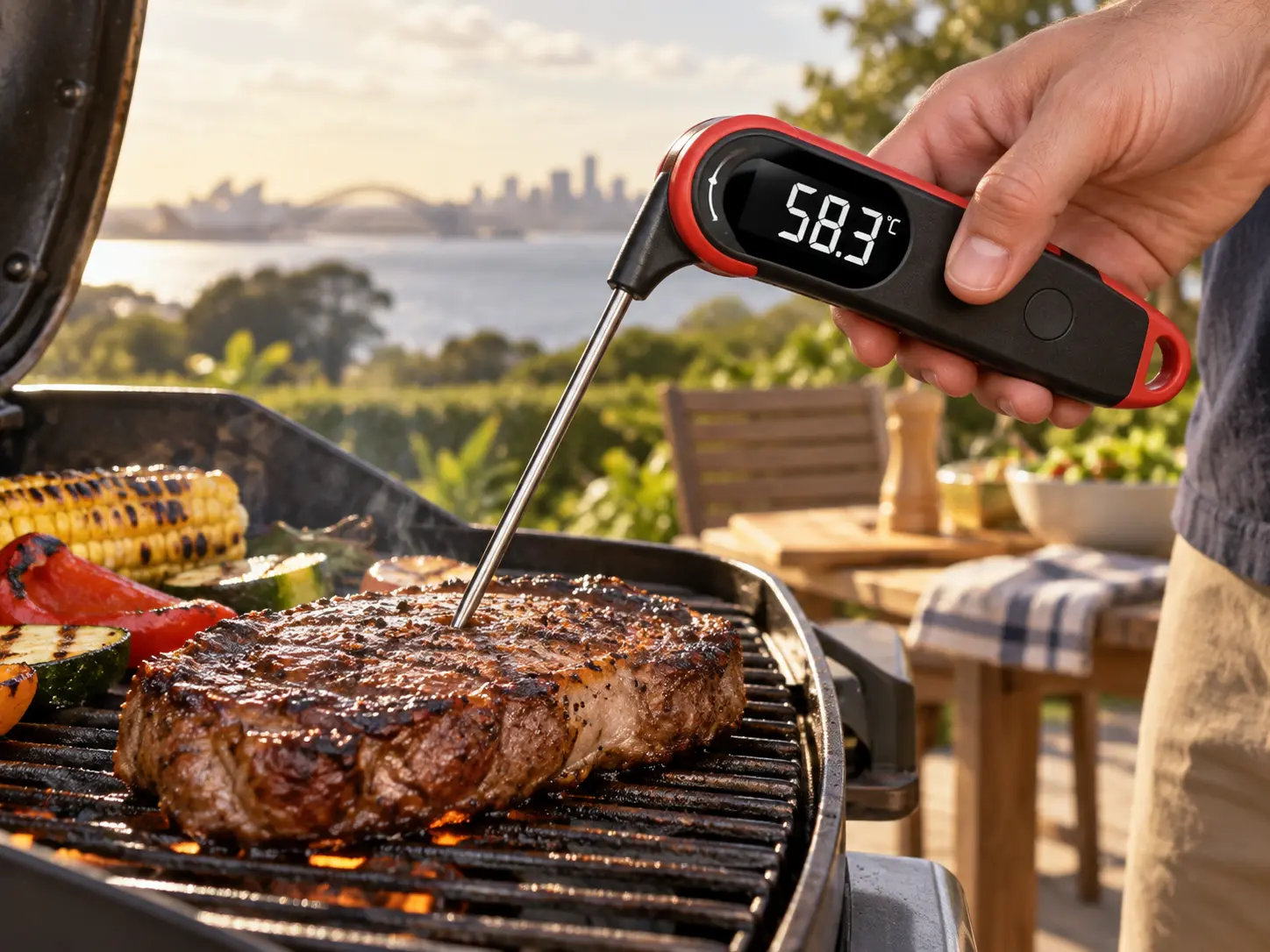
Illustrative editorial image, not an exact product photograph.
The TP622W combines a thermocouple sensor, claimed one-second response and ±0.5°F / ±0.3°C accuracy with a clear 180° auto-rotating display. Motion wake, a folding probe, magnet, hanging storage and recalibration support make it useful for steak, chicken, roasts, baking, frying and air-fryer food.
It is expensive beside basic probes and cannot monitor food continuously. The Australian review pool is also very small, and manufacturer-direct stock was marked sold out during research even though BIG W and Bunnings marketplace listings still provided broader Australian online availability.
What owners say
ThermoPro Australia displayed approximately 4.7/5 from six exact-model reviews: five five-star and one three-star. One reviewer said an earlier unit eventually became inconsistent and stopped reading. That is useful durability context but remains one anecdote, not a population-level failure rate. ProductReview separately showed 5.0/5 from one verified exact-model review—far too small to materially change the conclusion.
Pros
- Very fast claimed response
- Strong claimed accuracy
- Clear rotating display
- Recalibration support
- Useful beyond meat
- No app dependence
Cons
- Expensive for instant-read
- No leave-in monitoring
- Only six manufacturer reviews
- Direct stock was sold out
- Warranty wording is unclear
MEATER Pro / RTE-MT-MP201
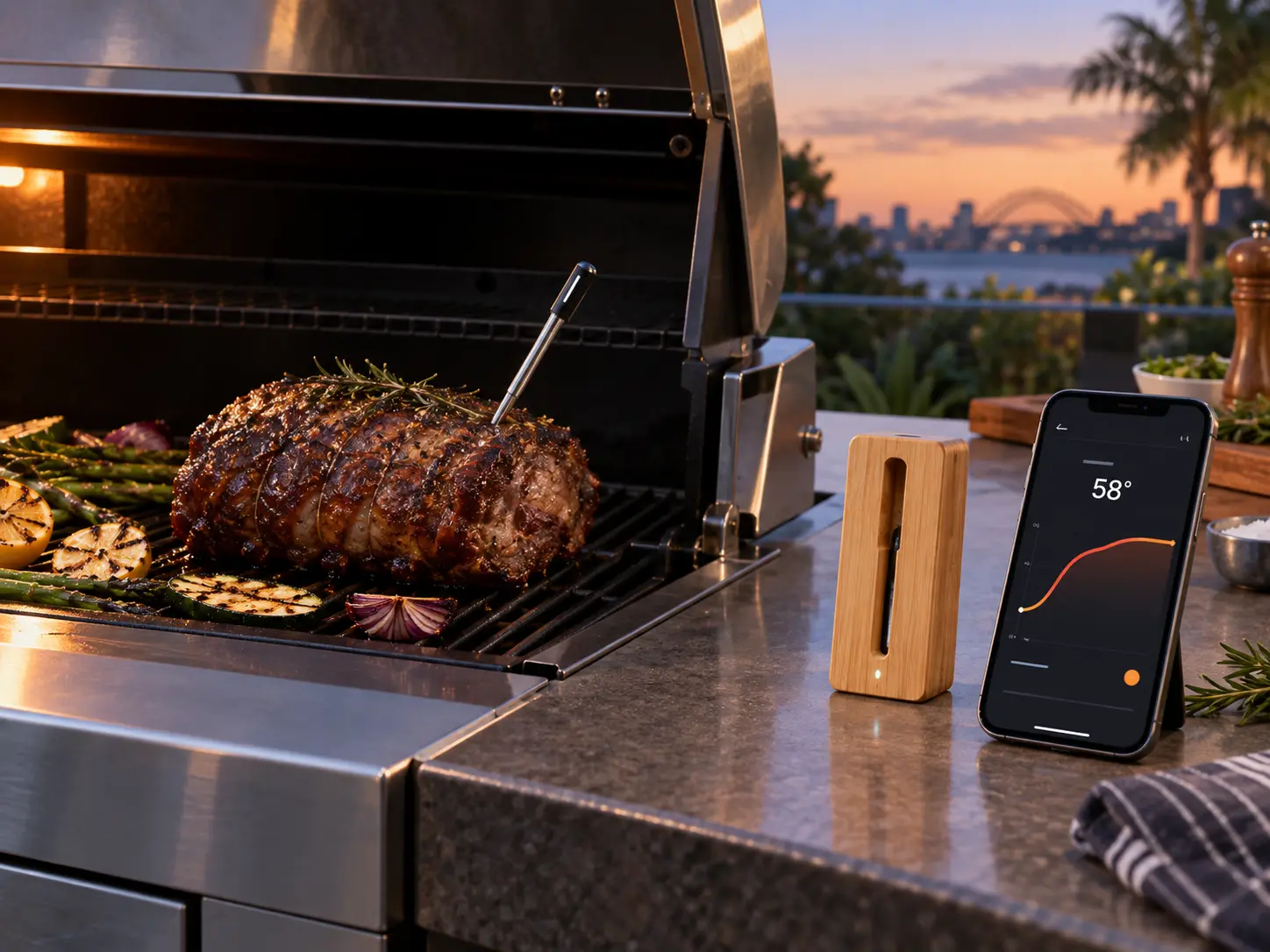
Illustrative editorial image, not an exact product photograph.
The MEATER Pro is a fully wireless leave-in probe rather than an instant-read tool. Five internal sensors and one ambient sensor feed the phone app's alarms, guided cooks and rest estimates. The waterproof 5mm probe tolerates about 105°C internally and about 550°C ambient, while Bluetooth 5.2 provides a quoted open-air range of up to roughly 75m.
At $249 it is expensive for one probe, and the app is required for the full value. Metal barbecue lids, walls and interference can reduce range; its 5mm body is awkward in thin foods; and long-term usefulness depends partly on app compatibility and software support.
What owners say
The Good Guys displayed 5.0/5 from six exact-model confirmed-purchase reviews and 100% recommend; some reviewers may have received an incentive. Praise centres on accuracy, consistent cooking and the app. JB Hi-Fi's separate exact-model listing displayed approximately 2.33/5 from six ratings. The two sources are not merged or averaged. The small, sharply conflicting Australian evidence base is a material reason this product does not score higher.
Pros
- No probe cable
- Five internal sensors
- High ambient-temperature limit
- Waterproof probe
- Useful guided cooking
- Established Australian retailers
Cons
- $249 for one probe
- Needs phone/app for full value
- Range can drop through metal and walls
- 5mm probe is poor for thin foods
- Australian ratings conflict sharply
- Software longevity matters
Weber Instant Read Thermometer 6750
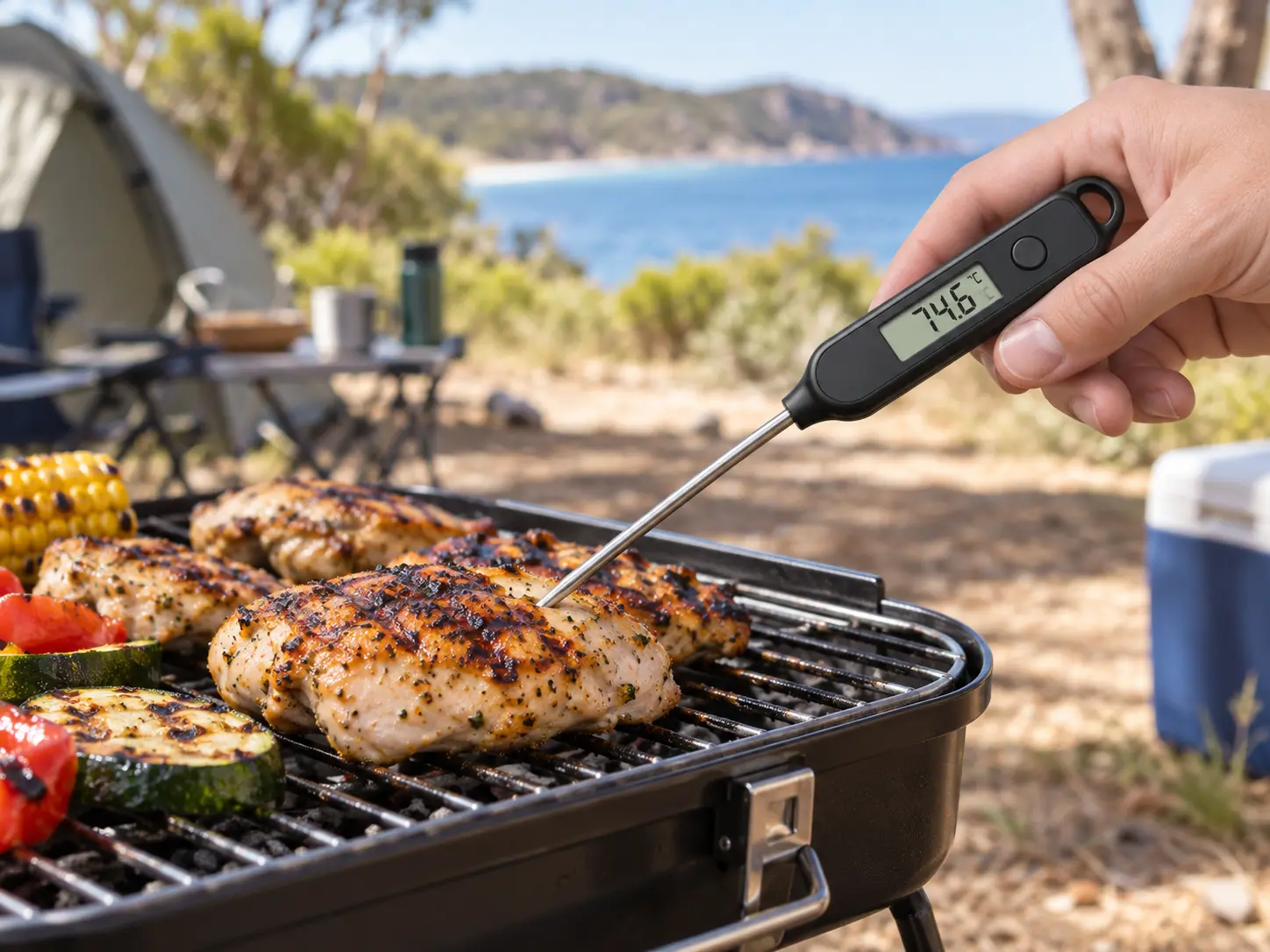
Illustrative editorial image, not an exact product photograph.
The Weber 6750 is deliberately basic: insert the slim probe, wait for the reading and remove it. It displays Celsius or Fahrenheit, measures approximately 8 × 33 × 205mm and needs no app, pairing or charging routine. That simplicity is its value proposition.
Weber says readings arrive “in seconds” but does not publish a premium response or precision figure strong enough to quote confidently. It is hand-wash only, is not presented as waterproof and provides no identified calibration feature, leave-in alarm or wireless monitoring.
What owners say
The Good Guys displayed 4.9/5 from 12 exact-model reviews and 100% recommend. Reviews are from confirmed purchasers, although some may have received an incentive. Owners consistently praise simple operation, quick checking and usefulness for roasts and barbecue, but 12 reviews remains a small sample.
Pros
- About $36
- Simple operation
- Compact slim probe
- Strong early retailer feedback
- No app or pairing
Cons
- No strong precision specification
- No exact response-time claim
- Not waterproof
- Hand wash only
- No calibration feature
- No leave-in alarms
Instant-read versus leave-in
Instant-read thermometers are inserted briefly for spot checks across steaks, chicken, roasts, baking and barbecue; they should not remain in the oven unless explicitly designed for it. Leave-in probes track long cooks continuously. Wireless models remove the cable but add batteries, connectivity and app dependence. Serious barbecue cooks may use both.
Response speed is how quickly a reading stabilises; accuracy is how close it is to the food's actual temperature. Manufacturer figures are claims rather than Worth Buying laboratory measurements.
Probe placement and accuracy checks
Insert the sensing area into the thickest, coldest central part, away from bone, metal trays and obvious fat, and check multiple points in irregular food. Thick wireless probes can be difficult to position in thin food. An ambient sensor beside the food and a barbecue lid gauge measure different locations, so their readings need not match.
Periodically compare the thermometer with a known reference and follow its calibration process where supported. Boiling water is not always exactly 100°C because altitude and atmospheric pressure affect boiling point.
Water resistance, cleaning and app ownership
IP65 protects the ThermoPro body against dust and water jets but does not make it submersible. A waterproof wireless probe and its charging dock may have different ratings; follow the exact manual and keep charging contacts dry. Smart probes add alarms and guided cooks but rely on app support, pairing, batteries and wireless range that can fall through metal lids and walls.
Australian food-safety essentials
Food Standards Australia New Zealand advises using a clean probe in the thickest part and waiting for the reading to stabilise. As a general guide, reaching 70°C in the centre helps ensure food is safe. Poultry, minced or rolled meats—including burgers, sausages, mince and rolled roasts—should reach at least 75°C in the centre.
Clean and sanitise the probe between uses, particularly when moving from raw food to ready-to-eat food. See FSANZ food-safety basics for current Australian guidance.
Which one should you buy?
Choose the ThermoPro Lightning TP622W for the strongest everyday combination of speed claims, display, recalibration and app-free spot checks.
Choose the MEATER Pro when you specifically need cable-free leave-in monitoring and will use app guidance through long cooks.
Choose the Weber 6750 for inexpensive occasional checks without premium features.
Useful FAQs
Is an instant-read thermometer better than a wireless thermometer?
Neither is universally better. Instant-read tools suit quick checks; wireless leave-in probes track temperature across long cooks.
Can I leave an instant-read thermometer in the oven?
No, unless the manufacturer explicitly identifies that model as oven-safe for leave-in use. The ThermoPro and Weber picks here are spot-check tools.
Where should I insert a meat thermometer?
Into the thickest, coldest central area, away from bone, trays and obvious fat. Check several points in irregular food.
What temperature should chicken reach in Australia?
FSANZ recommends at least 75°C in the centre of poultry.
Do meat thermometers need calibrating?
They should be checked periodically. Follow the manufacturer's process where user calibration is supported.
Can I wash a meat thermometer under water?
Only as allowed by its exact protection rating and manual. IP65 is not submersible, and probes, bodies and charging docks can have different protections.