
Thermapen ONE
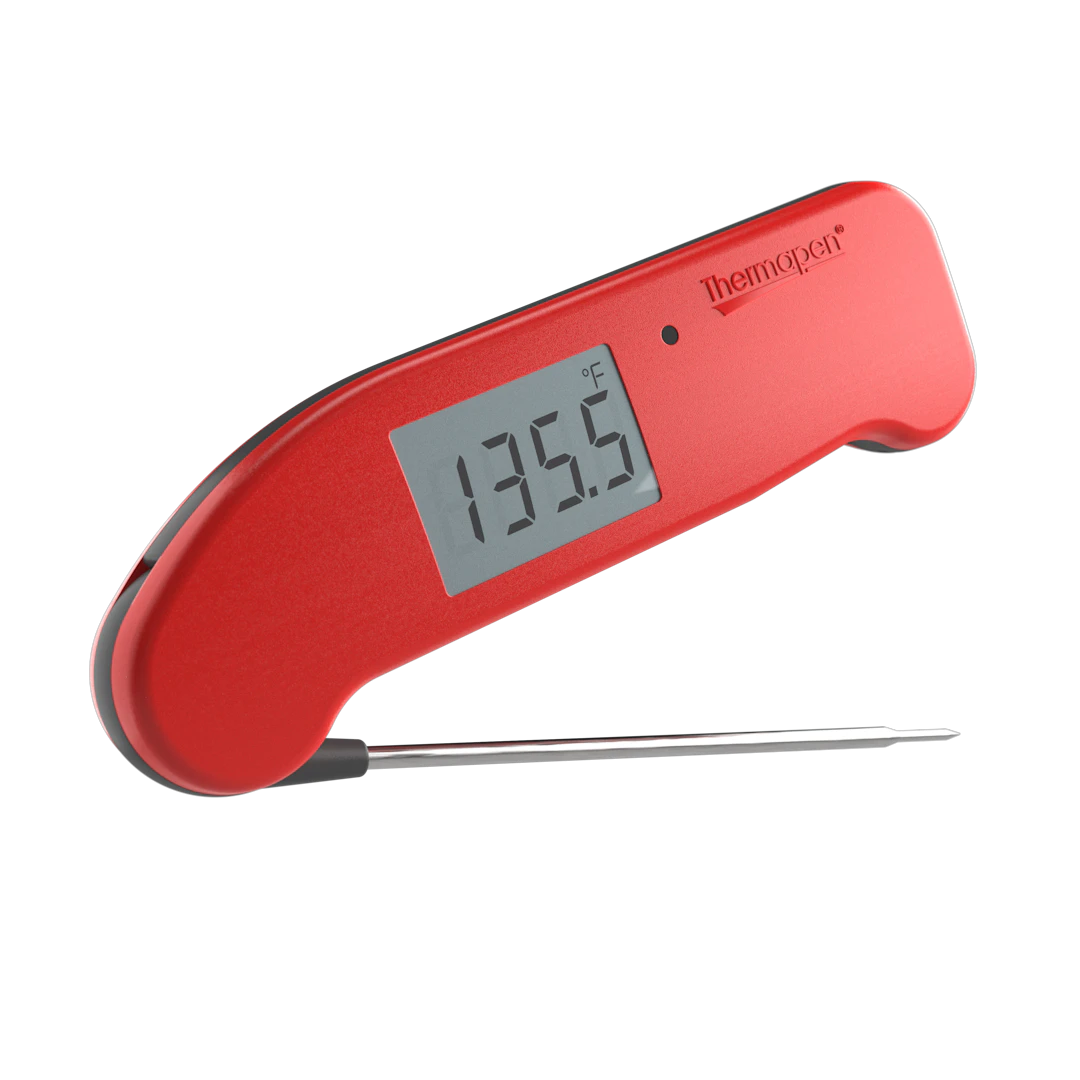
It settled faster than the Typhur Core in boiling and ice water in the same published test, and its four-way display is useful when you slide the probe into a thin steak from the side. Those advantages earn their keep when you’re checking several steaks or chicken pieces over a hot grill. The replaceable AAA also makes it straightforward to keep in service.
Specifications
| Probe | Folding thermocouple |
|---|---|
| Response | About 1 second claimed by the maker |
| Measuring range | −49.9°C to 299.9°C |
| Specified accuracy | ±0.3°C from −19.9°C to 119.9°C |
| Display | Backlit, rotates in four orientations |
| Water resistance | IP67. Follow the maker’s hand-cleaning instructions. |
| Power | One replaceable AAA battery |
Further product analysis
Checking several pieces.
Unfold the probe to switch it on. The display rotates when you turn the handle, which is useful when approaching a thin steak from the side or checking pieces at the back of a barbecue. Take a reading, lift the probe and move to the next piece.
How quickly it settles.
In the same published water test, the ONE took about one second in boiling water and four seconds in ice water, compared with three and seven seconds for the Typhur Core. The Core was a little faster in warm water. Both read close to the test targets. Allow the display to settle in food, where the time will vary with the starting temperature and where you place the probe.
What the extra cost buys.
The ONE is easier to justify when you use it often enough to benefit from quicker checks and a display that works at more angles. The replaceable AAA is also useful for long-term ownership. For occasional checks, the Inkbird covers the basics. If your main difficulty is seeing the digits at a dim barbecue, compare the Typhur’s wider display. Australian stock and support terms vary by seller.
Pros
- Fast readings with good independent accuracy evidence.
- Screen rotates in four orientations and lights up automatically.
- Replaceable AAA battery.
Cons
- Costs more than our other picks.
- Check colour and stock with the Australian seller.
Typhur InstaProbe Core HT06
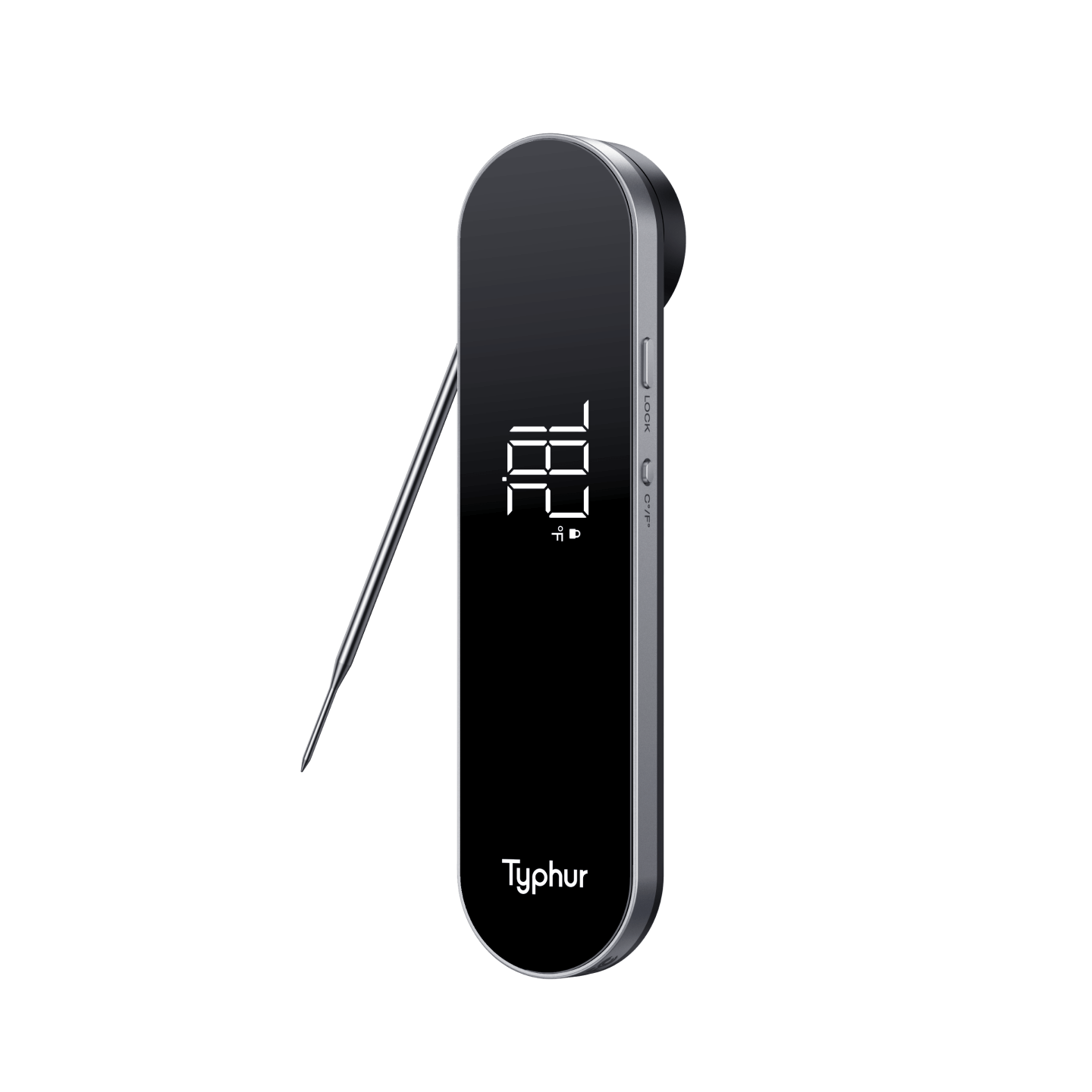
The large digits are easy to pick out when you lift the barbecue lid after dark, and the display flips when you switch hands. The magnetic back lets you park it on a suitable steel surface between checks, and the two AAA batteries are replaceable. The probe can still take several seconds to settle, so the everyday benefit is being able to read the temperature easily once it’s ready.
Specifications
| Probe | Folding, 11.43 cm |
|---|---|
| Response | 0.5 seconds claimed by the maker |
| Measuring range | −49.9°C to 299.9°C |
| Specified accuracy | ±0.3°C from −20°C to 120°C and ±1.0°C outside that range |
| Display | Wide illuminated display that flips in two orientations |
| Water resistance | IP67. Hand-clean as directed. |
| Power | Two replaceable AAA batteries |
Further product analysis
Reading it in low light.
The large illuminated digits are the Core’s main advantage. The display flips for the opposite hand and the magnetic back can keep it within reach on a suitable steel surface. The wider body can be awkward around tightly packed food, so the ONE remains worth considering if access and viewing angle matter more.
Display speed and probe speed.
In the published side-by-side water test, the Core took about three seconds in boiling water, four in warm water and seven in ice water. The ONE took about one, five and four seconds in the same tests. Both read close to the test targets. The Core makes sense when the screen is the part slowing you down. Give the number time to settle before acting on it.
Cleaning and ownership.
Use it for brief checks, keep the body away from sustained heat and clean it by hand. The two AAA batteries can be replaced. Australian warranty descriptions differ, so check the seller’s written terms before relying on extended cover.
Pros
- Wide, bright display for low light.
- Magnetic storage and replaceable AAA batteries.
- Good agreement with the water-test targets in the comparison.
Cons
- Some readings take several seconds to settle.
- The bulkier body can be awkward in tight spaces.
- Commercial warranty terms vary across listings.
Inkbird IHT-1P
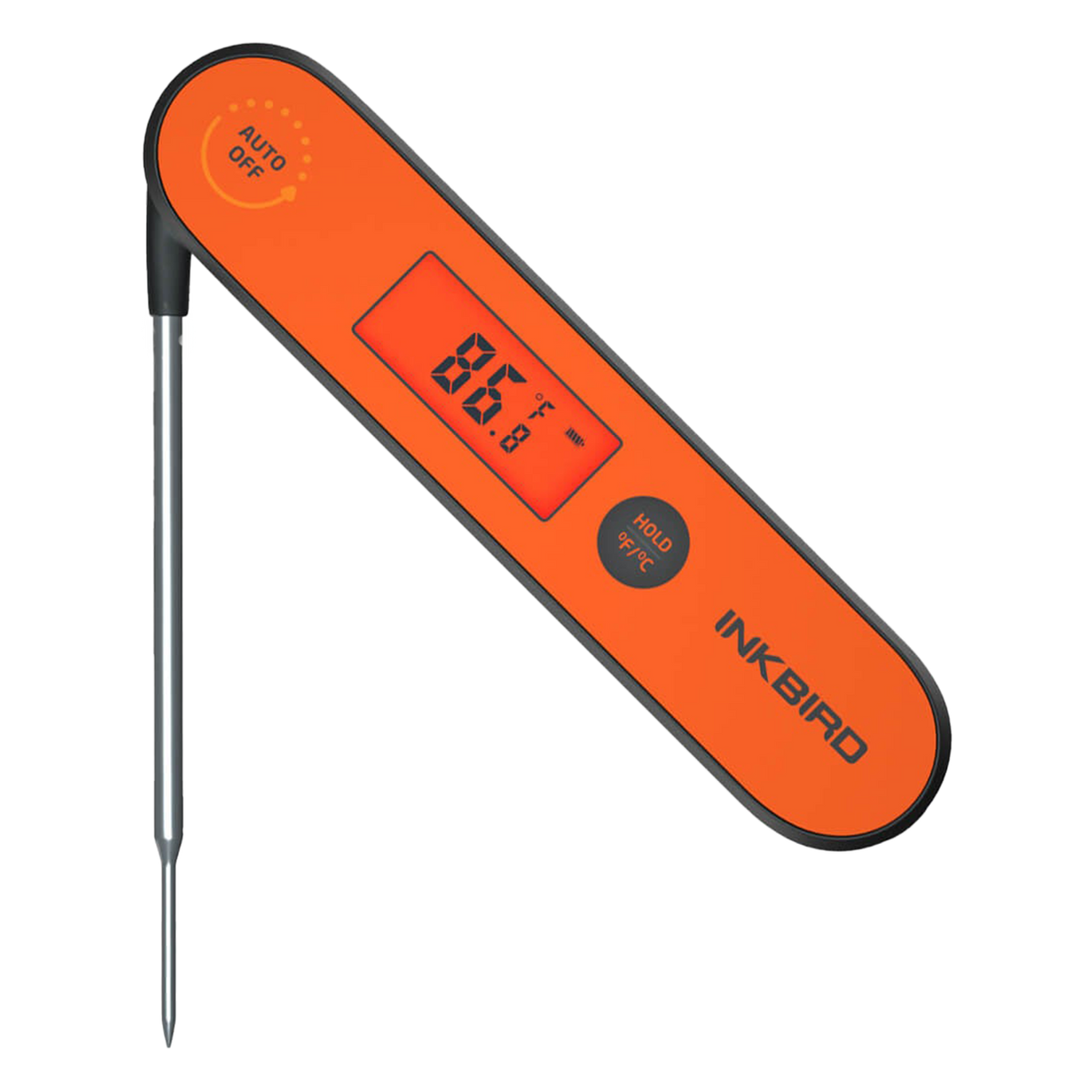
The backlight helps at a dim barbecue, and Hold lets you save a settled reading and check it after pulling the probe out. That’s handy when the display faces away as you reach the centre of a roast. USB charging means you can top it up between cooks. Its slower claimed response and wider accuracy tolerance are reasonable trade-offs for someone who mostly checks one or two cuts at a time.
Specifications
| Probe | Folding handheld probe |
|---|---|
| Response | 3–5 seconds claimed by the maker |
| Measuring range | −50°C to 300°C |
| Specified accuracy | ±1°C |
| Display | Backlit, with hold. Whole-degree display from 100°C. |
| Water resistance | IPX5. Keep the charging port covered when cleaning. |
| Power | Built-in 250 mAh USB-rechargeable battery |
Further product analysis
Where it earns its place.
The Inkbird is useful for occasional spot checks on a steak or roast. If the display faces away while the probe is in the food, let the reading settle and use Hold before withdrawing it. The display can update before the probe has settled, so wait for the reading to stabilise.
What you give up.
The maker’s 3–5-second response is slower than the premium picks’ claims, and its ±1°C specification is wider. Above the point where the display switches to whole degrees, small changes are harder to see. The ONE makes more sense if you regularly check several pieces quickly. The Core is the better fit if large, bright digits matter most.
Charging and care.
The built-in battery avoids buying disposables, but replacing an ageing battery is less straightforward than swapping an AAA. If charging fails, try the supplied cable and the power source specified by Inkbird. Avoid forcing the probe, keep the charge-port cover closed when cleaning and keep the body out of water.
Pros
- Affordable for occasional checks.
- Backlight and hold function are useful at the barbecue.
- Rechargeable battery and magnetic storage.
Cons
- Slower to settle and lower specified accuracy than the premium picks.
- Built-in battery and some cable compatibility reports.
- Keep the charging port protected when cleaning.
Other thermometers we assessed
View assessed alternatives
ThermoPro Lightning TP622W. Useful rotating display, but an independently tested Lightning took around three seconds in water transitions. Hand-clean it and keep it out of the dishwasher.
MEATER Pro. Useful for cable-free rotisserie cooking. Keep the dock near the cooker and test both connections with the lid shut. The maker limits the internal portion to 105°C and the ambient end to 550°C.
Weber 6750. Simple to use, but retailer feedback includes repeated display complaints. The Inkbird adds a backlight and hold button.
Other leave-in options. Inkbird IBT-4XS uses wired probes for a stationary cooker. Typhur Sync Dual and Inkbird INT-12-BW use wireless probes. The evidence did not support a wireless award.
How to choose a meat thermometer
Buying advice
For burgers, steaks and chicken pieces, choose a folding instant-read and check the thickest part. On thin cuts, insert the probe from the side so the tip reaches the centre. Avoid touching bone or the cooking surface. For several pieces, check more than one.
For slow roasts or smoking, a leave-in thermometer lets you set an alarm while the lid stays closed. A wired probe can suit a stationary cooker. A cable-free probe is useful when meat turns on a rotisserie. Check the probe and handle temperature limits, what the alarm requires and whether the system can keep working through the walls between your cooker and your phone.
Read the manufacturer’s cleaning instructions before the first cook. Waterproofing and dishwasher compatibility are separate. Keep the probe clean between uses.
Choose the Thermapen ONE for frequent checks, the Typhur Core for low-light readability or the Inkbird for occasional checks on a budget.
Australian food-safety essentials
Food Standards Australia New Zealand advises using a clean probe in the thickest part and waiting for the reading to stabilise. As a general guide, reaching 70°C in the centre helps ensure food is safe. Cook poultry, minced or rolled meats, liver and other offal to at least 75°C in the centre.
Clean and sanitise the probe between uses, particularly when moving from raw food to ready-to-eat food. See FSANZ food-safety basics for current Australian guidance.
Which thermometer should you buy?
Thermapen ONE — Choose this for frequent checks, fast settling and a replaceable AAA battery.
Typhur InstaProbe Core HT06 — Choose this when its bright, rotating display is the main benefit you need.
Inkbird IHT-1P — Choose this for occasional checks on a budget, allowing a few seconds for the reading to settle.
If you need to monitor food throughout cooking, choose a suitable leave-in thermometer instead; these picks are handheld instant-read models.
How we assessed these picks
Detailed methodology
We compared exact models sold in Australia using manufacturer documentation, published hands-on tests, retailer listings and owner reviews. See the side-by-side instant-read test for the water-test method. We considered how quickly readings settled, display readability, accuracy, care, power and local support. Where a source reports customer stars, we label whether the number is its published average or our screened sample. WBA scores out of ten are editorial judgements based on the product’s job and trade-offs.
Customer ratings remain separate by source; the Typhur figure is a screened sample.
Thermapen ONE uses manufacturer-hosted US product reviews. Inkbird uses manufacturer-hosted global product reviews. The Typhur figure uses a manufacturer-feed sample on Target US and may include incentives.
FAQs
Where should I put the probe in a thin steak or burger?
Insert it from the side so the sensing tip reaches the centre. Keep it clear of bone and the cooking surface. For an irregular cut, check more than one spot.
Do I need to check every piece when cooking a batch?
Check several pieces, especially the thickest ones and any that cooked in a cooler spot. Pieces of different sizes can finish at different times.
When should I trust the number on the display?
Wait until it stabilises. The starting temperature and the food affect how long that takes. If a reading looks surprising, check the probe position and take a second reading.
Can I wash these thermometers in the dishwasher?
Clean them by hand as the maker directs. Keep all three out of the dishwasher. Clean the probe between uses, especially after checking raw meat.
When is a leave-in thermometer worth using?
Use a purpose-built leave-in probe if you want to monitor a slow roast or brisket without repeatedly opening the cooker. These three picks are for brief spot checks. Remove them after taking the reading.