How we chose
We compared current Australian models using published CADR where available, filtration design, sensors, low-speed usability, genuine filter availability, warranty, current pricing and exact-product customer evidence. We did not physically test these purifiers. CADR and useful air-change context carry more weight than large headline room claims.
Philips PureProtect Pro 4200 — AC4221/11
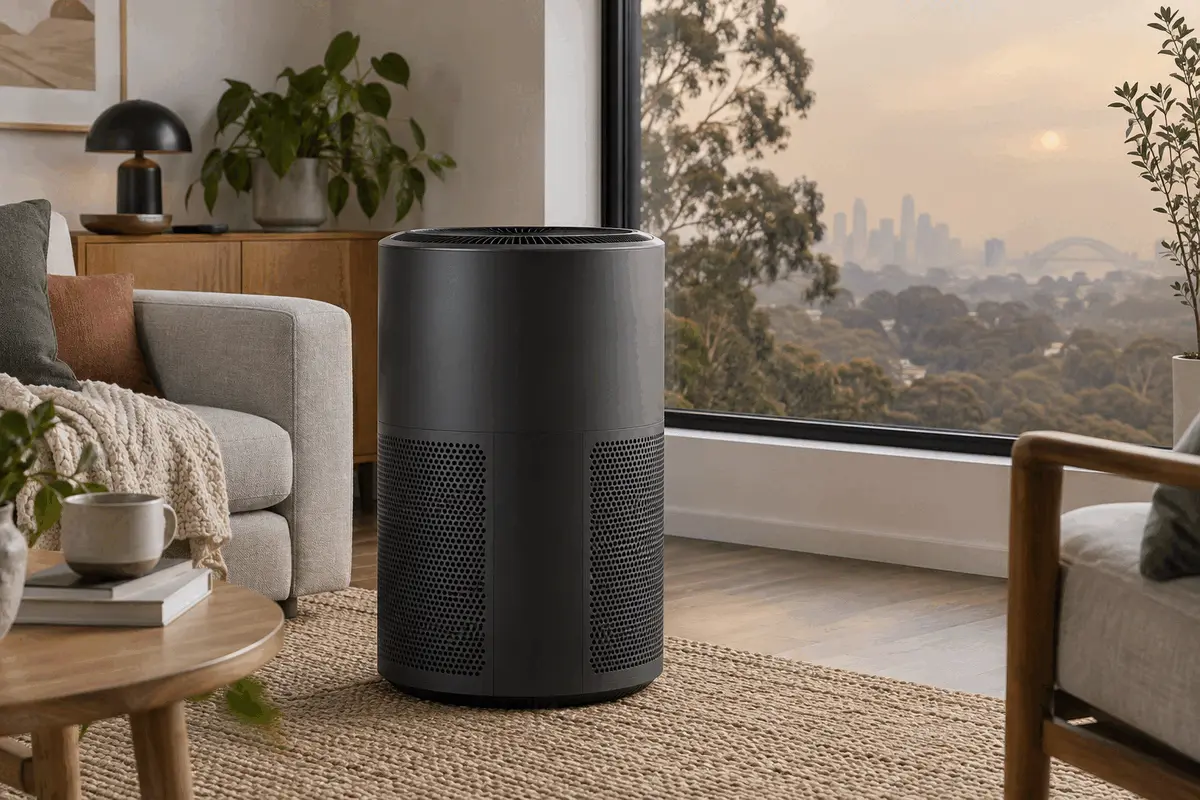
Illustrative editorial image, not an exact product photograph.
The metallic-black AC4221/11 combines 600m³/h published particle CADR with a pre-filter, HEPA NanoProtect and double active-carbon layer. PM2.5 and gas sensors feed automatic control, while Philips Air+, five speeds, Sleep mode and voice support add convenience without being necessary for filtration.
Philips advertises up to 156m². For smoke, pollen or allergy-focused cleaning, its published CADR points to about 50–63m² at four to five air changes per hour with a 2.4m ceiling. That is our practical calculation, not Philips' room claim.
| Exact model | AC4221/11, Metallic Black |
|---|---|
| CADR | 600m³/h particle CADR |
| Practical room guide | About 50–63m² at 4–5 ACH and 2.4m ceiling |
| Controls | Five speeds, Auto, Sleep, Air+ app, Google and Alexa |
| Noise / power | 15–51.5dB(A) claimed / 54W maximum |
| Dimensions / weight | About 28.5 × 28.5 × 52cm / 6.5kg |
| Filter | FY4200/30; up to one year claimed depending on use and air |
| Warranty | 2 years |
| Price | About $494–$498; RRP about $649 · checked 17 Sep 2026 |
Customer evidence
Appliances Online: about 4.8/5 from 44 reviews. The pool includes Bazaarvoice or syndicated manufacturer reviews and some alternate-colour 4200-series submissions; it is not presented as 44 verified Australian purchasers.
Philips Australia, separately: about 4.7/5 from 11 reviews, with 100% recommending. The two sources are not combined.
Pros
- Excellent published CADR
- HEPA plus double active carbon
- Particle and gas sensors
- Useful app and voice control
- Two-year warranty
Cons
- Costs about $500
- Replacement filters are ongoing expense
- One-year filter claim is conditional
- 156m² headline needs ACH context
- Smart features do not improve the filter itself
Shark NeverChange5 Air Purifier Max — HP300
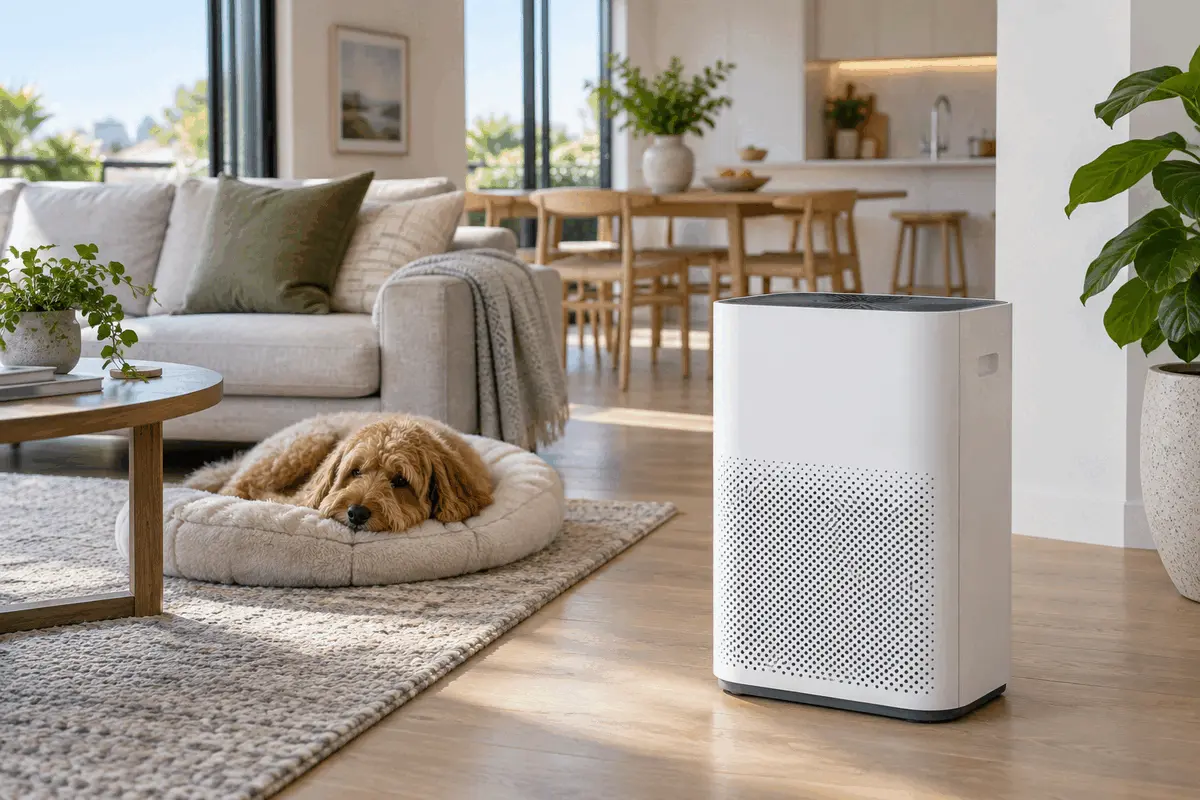
Illustrative editorial image, not an exact product photograph.
The HP300 uses HEPA filtration, Clean Sense IQ, PM1, PM2.5 and PM10 monitoring and removable debris-defence screens. It has Auto mode and manual fan control, but no app dependence. Shark does not publish an official CADR, which makes direct comparison less transparent.
Shark's 130m² headline is based on about one air change per hour. Its more useful published context is approximately 28m² at 4.8 air changes per hour. Shark also claims up to five years from the filter under specified testing and an approximately 50% CADR-decline threshold; that is conditional, not a guaranteed five-year life.
| Exact Australian model | HP300 |
|---|---|
| Published CADR | Not officially published |
| Room context | About 28m² at 4.8 ACH; 130m² headline is about 1 ACH |
| Filtration | HEPA, rinseable debris screens, odour-neutraliser cartridge |
| Controls / sensors | Auto and manual levels; PM1, PM2.5 and PM10 |
| Power / weight | 54W / about 5.6kg |
| Dimensions | About 57 × 33.5 × 33.5cm |
| Filter context | Up to 5 years claimed under specified conditions; replacement about $149.99 |
| Warranty | 2 years |
| Price | About $399–$405 · checked 17 Sep 2026 |
Customer evidence
Appliances Online displayed about 4.7/5 from 163 exact-product reviews. This is a large retailer-hosted feedback pool, but it is not described as entirely Australian verified-purchase evidence without individual provenance.
Pros
- Conditional long filter-life claim
- Rinseable debris screens
- Clear high-ACH room context
- Large exact-product review pool
- Simple automatic operation
Cons
- No official CADR
- Five-year claim is not a guarantee
- No app control
- Odour cartridge is not deep carbon filtration
- Shark direct stock was sold out when checked
Winix Compact — AUS-0850AAPU
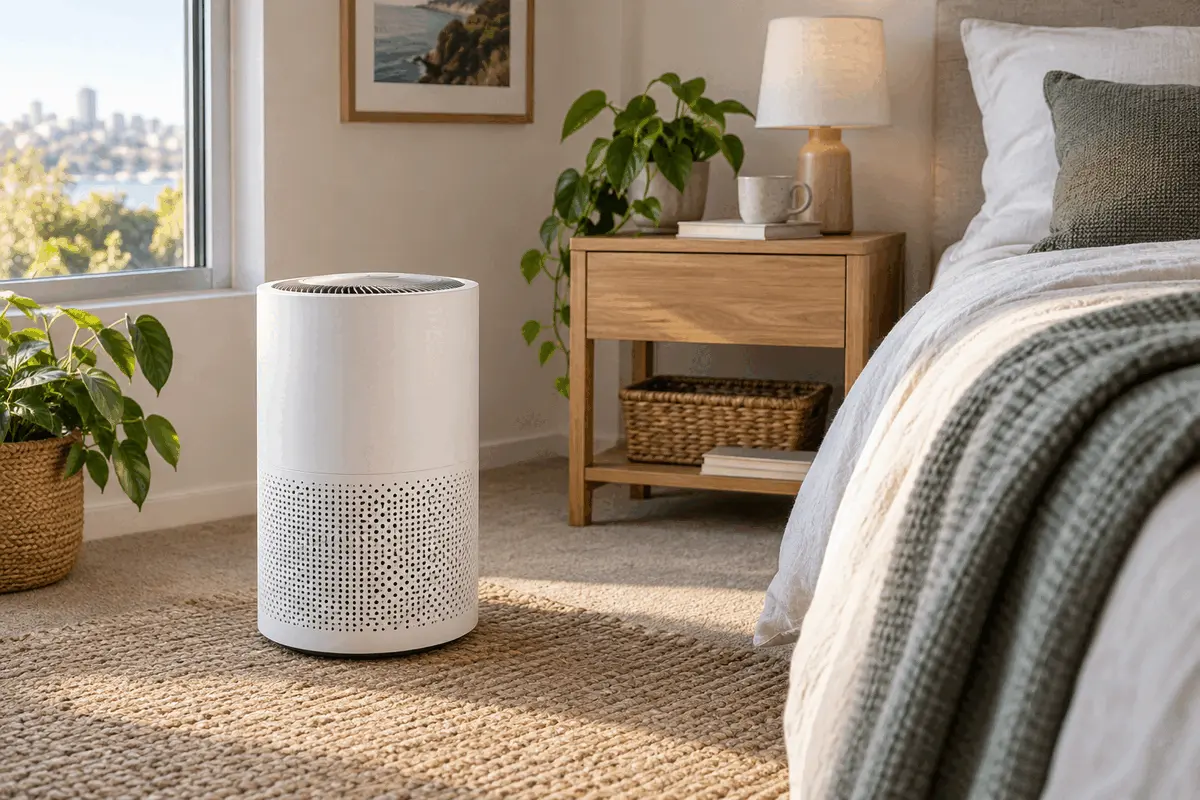
Illustrative editorial image, not an exact product photograph.
The AUS-0850AAPU publishes a 250m³/h CADR and combines a fine-mesh pre-filter, basic activated carbon, True HEPA and optional PlasmaWave. Automatic and Sleep modes make it easy to use, while the 3.1kg body is genuinely portable.
The 59m² marketing claim is too generous for high-turnover smoke or pollen duty. Its CADR supports about 21–26m² at four to five air changes per hour with a 2.4m ceiling: a useful bedroom or office range rather than a large open-plan area.
| Exact Australian model | AUS-0850AAPU |
|---|---|
| CADR | 250m³/h |
| Practical room guide | About 21–26m² at 4–5 ACH and 2.4m ceiling |
| Filtration | Fine-mesh pre-filter, carbon, True HEPA, optional PlasmaWave |
| Controls | Smart sensor, Auto mode and Sleep mode |
| Power / weight | About 55W / 3.1kg |
| Dimensions | About 371 × 241 × 241mm |
| Replacement filter | GQ-FILTER; about $80–$99 during research |
| Warranty | 2 years domestic |
| Price | About $284–$299 · checked 17 Sep 2026 |
What owners say
ProductReview showed 4.8/5 from 69 exact-model reviews, about 96% positive, with many verified Australian reviewers. Owners commonly praise quiet sleep operation, easy use, compact size, portability and perceived dust or allergen comfort. Negatives include occasional sensor, noise, delivery and service complaints; the carbon stage is basic.
Pros
- Published CADR
- Excellent exact-model owner evidence
- Compact and portable
- Quiet bedroom proposition
- Replacement filters currently available
Cons
- Not for large open-plan areas
- No app or Wi-Fi
- Basic carbon treatment
- Occasional sensor complaints
- Direct discount was sold out
CADR and realistic room sizing
CADR is the volume of cleaned air delivered per hour. Room claims can use very different air-change rates: 130m² at one air change per hour is not equivalent to 130m² at five. For smoke, pollen or allergy-focused cleaning, roughly four to five air changes per hour is a useful buying benchmark.
Using published CADR and a 2.4m ceiling, Philips works out to about 50–63m² and Winix about 21–26m² at four to five changes per hour. Shark does not publish CADR, so we use its own 28m² figure at 4.8 changes per hour rather than reverse-engineering one.
HEPA, carbon and replacement filters
HEPA handles particles
HEPA filtration mainly targets airborne smoke particles, pollen, dust and pet dander. A filter-efficiency percentage does not mean the same percentage of every particle in an entire room disappears immediately.
Carbon handles some gases
Activated carbon can help with some odours, VOCs and gases. Thin consumer layers and fragrance cartridges are not equivalent to specialist deep-carbon beds.
Long-term value depends on genuine replacement filters remaining obtainable. Philips FY4200/30 and Winix GQ-FILTER had current Australian support during research. Treat every “up to” life figure as conditional on smoke, dust, pets, fan speed and operating hours.
What an air purifier cannot do
An air purifier does not remove settled dust from surfaces, reduce indoor carbon dioxide, repair mould or moisture problems, replace source control, or make safe ventilation unnecessary. It can reduce airborne particles when correctly sized and operated, but it is not a medical treatment and should not be presented as preventing illness.
Also considered
Philips PureProtect 3200 AC3220/10 remains a strong lower-cost 520m³/h alternative. Winix ZERO+ PRO AUS-1250AZPU has strong pet-focused filtration and owner feedback, but current availability and filter cost are less attractive, and its own product page conflicts between 470m³/h marketing copy and 402.6m³/h technical data. Philips Mini 900 AC0951/13 is another credible compact option.
Which one should you buy?
Choose Philips PureProtect Pro 4200 AC4221/11 for the strongest transparent all-round clean-air package. Choose Shark HP300 when conditional long filter life and simple automatic use matter most. Choose Winix Compact AUS-0850AAPU for a bedroom or office where its smaller output, lower price and strong owner evidence are the better fit.
Useful FAQs
What is the best air purifier in Australia?
Philips PureProtect Pro 4200 AC4221/11 is our best overall pick for its 600m³/h published CADR, filtration, sensing and smart controls.
What CADR do I need for my room?
Multiply room area by ceiling height and your target air changes per hour. For a 20m² room with 2.4m ceilings at five changes per hour, target about 240m³/h CADR.
Do air purifiers help with bushfire smoke?
A correctly sized HEPA purifier can reduce airborne smoke particles indoors. Keep doors and windows closed during hazardous outdoor smoke when advised, and follow official health guidance.
Do air purifiers remove pet dander and odours?
HEPA can capture airborne dander. Activated carbon may reduce some odours, but performance depends heavily on how much carbon the purifier contains.
How often do air purifier filters need replacing?
Follow the indicator and manufacturer guidance, but expect smoke, pets and heavy use to shorten life. “Up to” intervals are not guarantees.